Showing posts with label college myth. Show all posts

12 Ways to Educate Yourself Without College

Guest post by Blake Boles. Cross posted at The Huffington Post

It's popular to criticize college today. No matter which way you look, somebody is writing about a student loan horror story, declining academic standards, disruptive technological change, or the narrow work options available to graduates.
Criticizing is easy, of course. Offering solutions is hard.
The reality is that college fills many valuable roles today. It offers young adults the chance to build hard skills (e.g. writing) and soft skills (e.g. teamwork), be part of an exciting community, live independently, get exposed to new ideas, and signal employers with an (increasingly devalued, but still valuable) college degree. College is pretty much the only place that bundles all these good things into one convenient package deal. That's why, despite the voluminous criticism, college as we know it won't disappear anytime soon.
But in an era of skyrocketing tuition fees combined with widespread economic austerity, millions of students will find themselves unable or unwilling to finance the college package deal. Yet they'll still want, and need, to gain a higher education.
Luckily, higher education doesn't have to be delivered by a college institution. You can gain skills, community, independence, exposure, and work opportunities by piecing together a self-directed, a la cartecurriculum of real-world projects. It's a like a design-your-own-college-major program — but without college or its inflated costs.
Self-directed learning is one solution to the college debate, and certainly not the only one. But unlike other solutions, you can begin self-directed learning immediately, without spending a ton of money or waiting for policy makers or university administrators to change their ways. And perhaps most importantly, self-directed learning builds serious personal entrepreneurship: an incredibly valuable "soft skill" in an era of rapid economic change.
Here are 12 ways to begin pursuing your own self-directed higher education, right now, without college:
  1. Kickstart something. Organize a Kickstarter or IndieGoGo campaign to raise money for one of your creative projects, upcoming trips, or educational ventures. You'll learn how to develop a product line, manage a budget, and market yourself with social media. Here how to get started.
  2. Write for an audience. 19-year-old Jason Lovett publishes short Kindle guidebooks; 20-year-old Weezie Yancey-Siegel interviews people she admires; 24-year-old Cameron Lovejoy shares poetry from his life on the road. No matter how you do it, writing for an audience sharpens your mind and helps you figure out what other people find valuable. (For fastest learning, work with aprofessional editor and solicit as much reader feedback as you can bear.)
  3. Take free or cheap introductory courses in multiple subjects. Introduce yourself to fascinating new ideas, people, and potential career paths using Coursera, The Floating University,Skillshare, Khan Academy, TED talks, DO lectures, Academic Earth, Udemy, or local community college classes.
  4. Compose a goal list and share it publicly. Think of this as your self-directed syllabus. Sharing it publicly will help keep you on track, as you'll feel accountable to the friends and family who read it and get excited about your projects. (Here's my list.)
  5. Recruit a mentorship team. Assemble a small team of trustworthy and knowledgeable people from whom you can seek guidance for your self-directed journey. If possible, include someone who currently works in your field of professional interest. Search Zero Tuition College to find mentors who understand the self-directed path.
  6. Develop a hands-on skill. Think: cooking, electrical work, sports instruction, or automotive repair. Such skills aren't easily offshored or automated and therefore offer an excellent part-time or fall-back work option (as well as much-needed relief from a computer screen). Don't dismiss such work as intellectually devoid; it's not.
  7. Couchsurf and volunteer your way across a country. International travel can be an incredible learning experience if you take the time to immerse yourself in the local culture. Do this—and save lots of money in the process—with the websites Couchsurfing, HelpX, WWOOF, andWorkAway.
  8. Start a tiny business. It doesn't cost a lot of money to start many types of businesses —perhaps $100 — and you don't have to think of it as a long-term venture. Whether you succeed or fail, you'll learn powerful lessons that most colleges can't teach.
  9. Teach. Record a series of instructional videos (they might land you a New York Times piece),offer a free online course, lead a hands-on class, tutor someone, or create a workshop for a conference.
  10. Enhance your peer community. Face-to-face community is a vital part of higher education. Without being formally enrolled, you can find community through online interest groups, local events, and workplaces. If you're seeking a huge concentration of 18- to 25-year-olds, simply move to a college town and join an off-campus student house.
  11. Practice, deliberately. "Deliberate practice" (DP) is the psychological process through which people attain deep expertise. Unlike regular practice, DP involves custom-tailored instruction accompanied by immediate, high-quality feedback. You can use DP to become a better violinist, swimmer, artist, or businessperson. But more importantly, you can learn the methodology behind the process and apply it to everyday learning situations. Start here.
  12. Build an online portfolio. Demonstrate your capacities to potential employers by creating a website that tells your story, displays your biggest accomplishments, and highlights the value you've created for other people. When someone asks you what you've been doing with your time instead of college, point them here. And keep your eyes on Degreed, RadMatter, and Knowit: new ventures that may help you quantify your self-directed learning and enhance your portfolio.
These are just a few ways to start giving yourself a well-rounded higher education without college. Do you have other suggestions? Please share them in the comments below.
You have read this article college myth with the title college myth. You can bookmark this page URL http://benncam.blogspot.com/2012/10/12-ways-to-educate-yourself-without.html. Thanks!

Big news! Turns out it is okay if you don’t go to college.

Didja hear it?  If you were able to catch any of NBC’s Education Nation conversation, It was ever so subtle, but it was there. The part of the conversation that disturbingly has been the banned from the Common Core College and Career Readiness mantra.

If you heard it you noticed that the language is changing, slowly but surely, from the lips of the politicians, corporate funders, and even from the administrators who feel they must not deviate from the party line (even when they know it's wrong) lest they lose their jobs.

So, what's the big idea that is ever so softly slipping through the lips of those engaged in the politically correct education conversation?

The new and improved stats and facts have arrived, and....

College AND career readiness is OUTTA HERE!

In its place is an important conjunction that many of us were shut down and smacked down if we dared to utter those two ugly letters.

So what are the two little letters that could change everything?


OR

Yes, though it had been banned from the vocabulary of the Common Core proselytisers,  “OR” is now an acceptable word.

But, of course, there’s a condition.

It must be followed by post-secondary certification.  The whole phrase looks like this:

“College OR post-secondary certification and career readiness” and it's a step in the right direction.

Oh...all the documents where that popular CCR (college career readiness) acronym will need to be found and replaced with CPSCCR.  

But actually, we could fix that, because many of us know what would make it even better would be to simply remove the words "post-secondary" as many young people are capable of getting a certification during their teen years.

So perhaps the new language will be:

College or certification and career readiness.  

Or to make it a really nice acronym we could call it

College or certification and career competency.   

Then the acronym could just be  C4 or C4

What's more the pundits are acknowledging their fatally flawed claims about the success the earning power of those w/college degrees verses those w/out.  They can no longer deny the facts. When you account for socioeconomic status and student loan debt  the stats about earning potential of college grads frankly, puts a lot of money in the pockets of our government and our colleges, but it's a load of crap.

So, what will this mean?
  • It will mean that educators are allowed to publicly acknowledge that, "One size does not fit all!".
  • It will mean that we can consider and honor the passions of ALL students.
  • It will mean that we no longer have to send the message to those in our society who did not take the college path that you are less worthy than those who did.
  • It will mean that we can value the contributions of all and help them think about and seek out which of many options will help them achieve their path.

And, of course, let's not be naïve. There was also probably some big trade school association that funded studies and hired lobbyists to march on Capitol Hill rallying for their piece of the pie. These decisions most always follow the money. So get ready to see a lot more certification programs vying for their piece of the post-secondary education pie.  

But, still, that means more choices and that will mean better options for students and when all is said and done, that is what matters most.  

Next step of course is to realize the value of the on-the-job training and apprenticeship opportunities that made my close family members and friends (Director, Accountant, Computer Programmer, Sound Engineer) six-figure income earners without degrees or post-secondary certification programs. And, BONUS! No college debt or years of lost earnings while pursuing a degree.

Too often, our leaders view life through the narrow lens of when they were in a four-year college. A broader view is required to lead on this complex issue today.  The goal must not be for a one-size-fits-all path to success, but rather on providing a menu of options that may or may not include college or certification.
You have read this article college myth / common core standards / Education Nation with the title college myth. You can bookmark this page URL http://benncam.blogspot.com/2012/09/big-news-turns-out-it-is-okay-if-you.html. Thanks!

Open Education Resources (OER) Brings Free and Affordable College Options Closer to Reality

I’ve been critical of the "Generation Debt"-producing “College for All” mantra in pieces like The College Myth: Why College isn't Worth the Cost for Many Careers Today.  However, Online learning and OER  (Open Education Resources) have tremendous potential for  driving down college costs.

In particular I’ve featured colleges like Harvard and MIT who are placing their classes online and organizations like University of the People and School of Everything who are sharing a variety of online learning opportunities. All of these options are being offered at little or no cost.  


In many cases students are able to take the reins and move through the courses on their own.  In other cases they use study groups like  Peer 2 Peer University or tutors to support them especially in some of the more difficult subject areas like Algebra or Physics where they may want or need additional support.

While getting a free education is fantastic, what is really promising is that now more and more places are offering accredited degrees for their classes. The classes give students access to online laboratories, self-assessments and student-to-student discussions. While access to the course content is usually free, there will be an affordable charge for a credential.

Perhaps what is most groundbreaking is what Stanford professor Daphne Koller shares with us in her recent TED Talk. Koller is excited to be making the college experience available to anyone through her startup, Coursera which currently has classes from 16 top colleges. While colleges have been putting lectures online for years, Coursera's platform supports the other vital aspect of the classroom: assessments and assignments that reinforce learning with a unique peer to peer system of evaluating student work.  

Koller points out that the future of education is here now. She shares how people from around the world are learning at their own pace and getting together online with thousands of others to learn globally while also putting together traditional supports like face to face or online study groups or tutors to support that learning.  

To get more of an insight into what this might mean and look like, check out Koller’s TED Talk below.

You have read this article college myth / oer / online learning / open educational resources with the title college myth. You can bookmark this page URL http://benncam.blogspot.com/2012/08/open-education-resources-oer-brings.html. Thanks!

Four Reasons to Consider a Non-Traditional College Program

College grads are having a hard time getting jobs these days.  Anthony Cody recently explained to us that the failure of schools is not that they are not teaching students to become skilled workers, but instead it is not giving them enough experience with doing things in the world. Employers don't want to hire people who learn the theory behind or are "trained" to do things. They want people that have actually done things.

Students are waking up and realizing that in many cases the traditional four year “college experience” doesn't set them apart from the rest and provides few guarantees for employment related to their degree upon graduation.  


Fortunately, there are colleges like Sanford Brown that are hearing this message loud and clear and they are being designed with a focus of providing programs that result in jobs for grads and also give them the flexibility to hold a job and get experience while doing so. That’s possible in part because these  institutions are offering online learning opportunities. More and more young people and people who never completed college are realizing the benefits such as schedule flexibility and a lower cost than traditional options. 


This lets them get a degree as fast as possible to practice in a field that’s in demand and start making their dreams come true.

Here are four benefits of online education programs:
1. Save Time
You can complete an online education program in about half the time required to complete an undergraduate education at a four-year university.
2. Take Relevant Courses
At an online college, you are in full control of your educational experience. You are able to choose all of the classes that you want for your educational experience. You do not have to waste your time sitting through pointless classes that have nothing to do with the actual things you want to accomplish in life. You can choose classes that will give you the practical skills that you need to succeed in the business world or whatever career that you ultimately decide upon.
3. Pay Less for Online Courses
Online educational programs cost less than traditional programs resulting in significant savings for students. With an online program, you can save yourself from paying thousands of dollars in tuition fees. You will also be able to save money on the cost of finding an apartment to rent at or near a college campus. Apartment rentals on college campuses tend to be very expensive in comparison with apartment rentals that aren’t in the heart of a college town.
4. Have Time for On The Job Experience
Online college programs offer a schedule that is more flexible than a traditional college. This gives you the time you need to acquire the on-the-job experience as an employee, apprentice, or intern that will help you get that job upon graduation.  

Choosing to pursue an online education is a smart idea for the person who is on a budget and does not want to waste time in taking irrelevant classes. It requires diligence and discipline, but the result could be a savings in time and money while providing more options for success upon graduation.
You have read this article college myth / online learning with the title college myth. You can bookmark this page URL http://benncam.blogspot.com/2012/07/four-reasons-to-consider-non.html. Thanks!

How Self-Directed Learners Earn a Living Without a College Degree

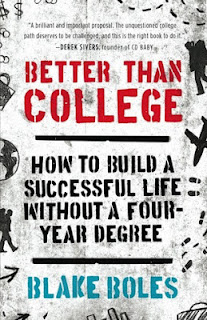
Guest post by Blake Boles, author of Better Than College: How to Build a Successful Life Without a Four-Year Degree. This post is excerpted from the chapter “Financial Security Without College, Part Two”

How do self-directed learners actually make their livings? Can they earn a decent amount of money? Who has taken this path successfully?


There are a number of stories about self-directed learners who skipped or dropped out of college. The following story is one that succinctly illustrates the answers to these questions.Ben Hayes, a lifelong unschooler from New York City, spent much of his youth playing games of all types—video games, computer games, board games, and card games. At age 13, he got an internship at Gamelab, a NYC-based game design company. After Ben spent three years building his skills and demonstrating his value, Gamelab hired the 16-year-old as a full-fledged designer and started paying him a steady income.

At the same time, Ben was intensively playing Magic: The Gathering (a card game), working his way up through the tournament system. He soon became one of the top-ranked Magic players, a position that allowed him to explore the world as he traveled to international competitions.


When he turned 17, it seemed logical to Ben to give college a shot. He applied to Parsons, a design school, and was awarded a merit-based scholarship, but after one semester, the choice seemed wrong. Ben transferred to another NYC-based college for a semester, but his classes continued to leave him unsatisfied. He decided to go back to focusing on what he loved, building and playing games. Ben is now 21 and works as the lead designer for Playmatics, a computer gaming startup.


While self-directed learners must embrace their inner entrepreneurs in order to find financial security, they don’t necessarily have to start businesses to make a living. Many, like Ben, simply take jobs that match their passions. After building a solid track record with one or two companies, self-directed learners possess real work experience—an asset that employers value greatly—and their nontraditional educations become a nonconcern. In fact, their backgrounds often can become a valuable distinguishing factor during the hiring process. Another way that self-directed learners make a living is by focusing on what they love, building mastery, and then producing a respected piece of work. They publish articles, build websites, film short movies, code software, or create art, and, when their work garners the attention of a wider community, they figure out how to use their newfound audience to make a living of some kind. Sometimes they perform or compete in a major venue; sometimes their accomplishments go viral on the Internet.

Many self-directed learners do start their own businesses. Sometimes these businesses are wildly successful (think Mark Zuckerberg and Bill Gates), but more often they’re small and simple yet generate enough money to let a young adult live independently, travel often, and do what they love. By embracing entrepreneurship at an early age, self-directed learners give themselves enough time for trial and error so that they can build a reliably profitable enterprise.Sometimes self-directed learning instead leads you back in the direction of formal education, and you find yourself in a cooking school, long-term apprenticeship, high-level training program, or, yes, even a focused college program that provides a route to profitable employment.Finally, many people who don’t go to college gain competency in a hands-on vocation that’s universally valued and unlikely to ever be offshored or automated, such as health services, construction, electrical work, landscaping, cooking, or small-scale farming. They then use the vocation as a part-time income generator or temporary back-up job.


For example, after I finished my self-directed college program (which handed me a degree but absolutely no job opportunities), I took two short and inexpensive courses that trained me as an Emergency Medical Technician and Wilderness First Responder, positions that I then used to work as a medic for summer camps and outdoor education programs. I also exploited my ability to cook for large groups—a skill I taught myself while in college—to earn money in food service while I was working on my writing.


Most college-skipping self-directed learners pursue many of these paths at once. Just as Ben Hayes focused on paid employment while also competing in Magic tournaments and experimenting with college, you can work toward creating a respected piece of work, build a small business, seek meaningful employment, and develop a vocation all at the same time. By keeping multiple opportunities open, self-directed learners build their financial security without forsaking their interests and values in the process.


What about money? Don’t college graduates make more money than nongraduates? On average, yes, they do. But there are a few important caveats.In a 2007 report, the nonprofit college-preparation organization College Board stated that college graduates make $800,000 more in their lifetimes than their non-college-educated counterparts. However, they retracted the number in 2009; the author of the report said that $450,000 may be a more reasonable estimate.[1] When including the costs of student loan payments, forsaken work opportunities, and ballooning tuition fees, the number may even be as low as $280,000.[2] This is still a significant figure, but it is not nearly as much as we’ve been 
popularly led to believe.


The “average” lifetime earning gap also conceals a huge income variation based on one’s college and field of study. Petroleum engineering majors can easily earn twice the income of child and family studies majors. Princeton and MIT graduates typically earn three times as much as Coker College alumni.[3] Graduates with liberal arts degrees from noncompetitive colleges may well earn less than sales managers, real estate brokers, and other people whose positions don’t require a college degree.[4]
Here are a few more reasons why the lifetime earning gap between graduates and nongraduates shouldn’t scare you:
  • When you don’t include graduates of the Ivy Leagues and other elite colleges, the gap in average lifetime income narrows even more.
  • Income is not the same thing as wealth. Many college graduates (and adults in general) may have high incomes, but they might also be up to their ears in debt.
  • Earning a high income can become a detriment to learning how to live frugally, which is an incredibly valuable life skill in the age of the entrepreneur.
  • Money is just money; time is life’s true commodity. If you’re going to college in pursuit of some mythical six-figure income, that’s a poor gamble to make with four precious years. On the other hand, pursuing an adventurous, self-directed education guarantees you a value-filled experience.
Blake Boles is the author Better Than College: How to Build a Successful Life Without a Four-Year Degree, which launched last week (www.better-than-college.com). If you’re a student or teen, you may download the book for free.  Follow Blake at www.blakeboles.com.

[1] Mary Pilon, “What’s a Degree Really Worth?” Wall Street Journal, February 2, 2010, http://online.wsj.com/article/SB10001424052748703822404575019082819966538.html. [2] Ibid. [3] “Degrees That Pay You Back” and “Salary Potential By School Location,” 2011–2012 PayScale College Salary Report, PayScale, accessed February 20, 2012, http://www.payscale.com/best-colleges. [4] “20 Great Jobs That Don’t Require a Degree,” CNN (CareerBuilder), posted February 24, 2006, http://www.cnn.com/2006/US/Careers/02/24/cb.no.degree.jobs. Specific income figures from various colleges, majors, and professions change annually, so I’ve tried to make statements that will generally hold constant. Crunch your own numbers by visiting sites like PayScale.com or searching online for average earnings.
You have read this article college myth / homeschooling and career / homeschooling and college with the title college myth. You can bookmark this page URL http://benncam.blogspot.com/2012/06/how-self-directed-learners-earn-living.html. Thanks!

Skip College, Go to Work in a Hot Startup

Guest post by Tom Vander Ark | Getting Smart
Skip College, Go to Work in a Hot Startup

The much vaunted American higher education system coasts on the reputation of the top three dozen schools which themselves gain much of their stature simply by excluding 85% of applicants.   Most post secondary institutions just don’t add much value and can no longer justify outrageous tuition.
As recent graduates of American universities, Shaila Ittycheria and Kane Sarhan came to this conclusion and they decided to build an alternative.  E[nstitute] is a two year apprenticeship program empowering young adults to learn from and work with top NYC entrepreneurs.”
“Higher ed is not working,” Kane said, “but internships do.”  Shaila and Kane are targeting 18 to 24 year olds with no bearing on where they are in formal education. The first class of 15 young people will begin working with 35 entrepreneurs in August.
Their geeky website explains that “In probability theory, E[x] stands for expected value, which is why E[nstitute] uses brackets in its name.”
Participants will start their two year work study at the bottom of totem pole but they will gain valuable experience and exposure to top entrepreneurs in fast-paced startup environments.  In their second year, apprentices pick a “major” and focus on building a marketable skill.
Kane and Shaila have been learning from two of my favorite people, Dennis Littky from Big Picture Learning, and Bror Saxberg from Kaplan.  If they can combine what Litkey knows about internships and what Bror knows about online learning, they’ll create powerful alternatives to traditional higher education for many young people.
Formed as a nonprofit organization, E[nstitute] seeks to create transformative learning experiences for young people.  Kane and Shaila are fundraising to launch and scale the program but think it can become largely self-sustaining in the future.
In the process, E[nstitute] may just redefine the higher education landscape by turning thousands of startups and small businesses into classrooms.
See the HuffPo feature on E[stitute]. Read more at The Next Web and PSFK. Read an interview with one of the partners of E[stitute]. Read why one innovative educator isn't impressed with E[stitute]. For more higher ed disruption, see Start Making: General Assembly Launches Online.
This post first appeared on Huffington Post and Getting Smart. 
--------------------------------------------------------
Note:  Applications for this year are closed. Applications for next year are expected to open in the fall.
You have read this article college myth with the title college myth. You can bookmark this page URL http://benncam.blogspot.com/2012/05/skip-college-go-to-work-in-hot-startup.html. Thanks!

12 Most In-Your-Face Reasons Why I Will Not Go Back to College

I've often shared my disappointment with the "College for All" mantra that has become pervasive in education reform today.  College for some? Sure. College for all? Absolutely not. There are many reasons that college is not the best choice for some people.  Go check out this 12 Most post that I supported uncollegian Cinque Mcfarlane-Blake in composing.

12 Most In-Your-Face Reasons Why I Will Not Go Back to College
You have read this article college myth with the title college myth. You can bookmark this page URL http://benncam.blogspot.com/2012/03/12-most-in-your-face-reasons-why-i-will.html. Thanks!

Six Propositions to Consider Before You Consider College

I’ve been a fan of Blake Boles’s (author, Zero Tuition College) ideas for quite some time. I reached out to him directly when I wrote a post that shared his 11 Great Reasons to Skip College inviting him to share more of his ideas here.  He agreed! The following post is an excerpt from the newest book he is writing, "Better Than College." If you like his ideas, please consider helping him out by visiting his fundraising site here where you can learn more and pre-order the book.
PHOTO: (credit Flickr/Earlham College) http://www.flickr.com/photos/earlhamcollege/4618231007/sizes/z/in/photostream/
While the idea that you can skip four-year college and still get a higher education may seem nuts, Blake Boles is writing Better Than College: How to Build a Successful Life Without a Four-Year Degree, a book on how to do just that. Below is an excerpt from the book where Boles shares six propositions to help you see why Zero Tuition College —the alternative learning method described in his book—holds just as much life-changing potential as traditional college.

Proposition #1: College is just too expensive.
Today, the liberal arts college experience offers many valuable things: exposure to new ideas, analytical skills, social networks, support, accountability, and the opportunity to live independently. But these good things come at a high price. The average family will shell out roughly $20,000 per year for tuition and living expenses,[1] while the average student who takes out loans will graduate with more than $25,000 in debt.[2] And this isn’t a recent trend: since the 1950s, college tuition has risen almost twice as fast as inflation.[3]

When the price of oil rises, we look more seriously at alternative energy. When a business raises its prices, we consider different ways that we could obtain the same goods or services. But even though the price of college has skyrocketed, we flood its gates. Why?


Proposition #2: Higher education and college are not the same thing.
We spend big bucks on college because we’ve confused receiving a college degree with getting a higher education. They’re two different things.

A college degree proves that you can survive four years at an institution. It’s a piece of paper that says, “I followed a prescribed path to success.”

Higher education, though, is the capacity to self-direct your life. Someone who has a higher education can define her own vision of success and pursue it, even in the face of difficulty.
College is one path to a higher education, but it’s not the only one. Sometimes college graduates lead self-directed lives, and sometimes they don’t; a college degree does not guarantee a higher education.

Proposition #3: You can give yourself a higher education without college.
So how do you give yourself a higher education, if not via college? That’s the challenge this book addresses. Here’s an overview of the answer.

Instead of following someone else’s curriculum, self-directed learners begin by asking themselves what fascinates and drives them. Their journey begins—and ends—with self-knowledge.

Instead of taking full-time classes, self-directed learners give themselves assignments that they find interesting, eye-opening, and challenging. They start businesses, find internships, travel the world, read and write about things that fascinate them, and work for organizations they admire. Many college students do these things too, but the difference is that self-directed learners don’t wait for anyone’s permission to begin learning.

Instead of working on homework, papers, and presentations destined to be seen once and tossed into a trash can, self-directed learners turn much of their hard work into useful products for other people. They write blogs, build start-ups, create art, record videos, teach their skills, and sell their services. They keep an eye out for the innumerable ways that they can improve someone else’s life.

Instead of relying solely upon professors and college guidance counselors to help direct their educational process, self-directed learners seek the mentorship of a variety of accomplished individuals. They consult family, friends, businesspeople, writers, researchers, working professionals, retirees, or anyone else who might help them. They keep themselves accountable by sharing their goals publicly and asking friends and mentors to keep them on track.

Instead of purchasing peer community through college, self-directed learners meet friends through their work, hobbies, travel, networking, and social media—just as people do in the real world. They try to surround themselves with as many smart people as they can.

To become financially secure, self-directed learners figure out how to market themselves, get hired in unconventional ways, start their own ventures, and live within their means. They recognize that these abilities—not a degree—are the true assets of an economically resilient life.

By doing these things, self-directed learners gain many of the benefits that we associate with higher education—knowledge, skills, self-awareness, exposure, emotional growth, self-discipline, and work opportunities—for a radically lower price than the tuition of a traditional college.

Proposition #4: Skipping college isn’t the best idea for everyone.
Replacing college with self-directed learning is a good idea for many students, but not everyone. There are some people for whom college is clearly the best choice.

If your goal is to enter a licensed profession—to become a doctor, lawyer, architect, public school teacher, engineer, or other government-licensed professional—then you should go to college.

If you want to do PhD-level research—to study cancer, publish neuroscience papers, or teach university-level history—then you should go to college.

If you’d like to work for a major investment bank, consulting firm, or other wealthy institution that heavily values adherence to social norms, then you should go to college.

If you harbor a deep love for a specific academic discipline, want to work with certain professors, or crave the challenge of reading dense academic material, then you should go to college.

But if, on the other hand:
  • you suspect that becoming a doctor, lawyer, architect, scientist, professor, or financier is really somebody else’s goal for you,
  • you’re interested in the liberal arts, studio art, technology, entrepreneurship, or working with your hands,
  • you suspect that you haven’t seen enough of the world to really focus in college,
  • you’re mostly interested in the social aspect of college,
  • or you’re simply unsure about everything,

then postponing, leaving, or skipping college might be the best thing you ever do.

Proposition #5: It’s a gamble either way.
If you skip or leave college in order to pursue a self-directed, adventurous, and entrepreneurial higher education, you’re taking a gamble. It might not work out. You may live with your parents for a while, have trouble making money, and suffer the embarrassment of trying something different and failing. You may have to go back to school.

But if you go to college because you believe it’s a safe path, because you want to avoid criticism, or even for one of the aforementioned good reasons, you’re also taking a gamble. It might not work out. You may live with your parents for a while and have trouble making money. You may have to go back to school. But—unlike in the self-directed path—you may end up with massive amounts of student loan debt at the time in your life when you’re supposed to be most free.

I’m not able to tell you which gamble is more appropriate for you. But I’m confident that the first gamble—crafting your own adventurous and entrepreneurial higher education—will teach you things about yourself that the second never could.

Proposition #6: There’s a culture of fear around college, and it’s the wrong one.
It’s difficult to make a rational decision about college when parents, politicians, educators, and pretty much everyone else rallies behind a college-for-all banner. When you choose to skip college to pursue your own higher education, you’re truly bucking the establishment. That’s a scary thing to do.

To illustrate: when I started writing articles about Zero Tuition College, my friend Sarah wrote me an e-mail.

“There is a cultural voice that lives inside my head,” Sarah explained. “Whenever I start reading an article that’s critical of college, this voice starts shouting: You need a college degree to be taken seriously and earn a real living! It takes a lot of work to quiet that voice down. Perhaps you can launch a preemptive strike against it?”

That’s when I realized that this book needed to be written. We’re in the midst of a college mania that threatens the livelihoods of indebted students as well as the financial stability of the countries that provide billions of dollars in easy loans to those students.

At the time of writing, total outstanding student loan debt in the US had reached one trillion dollars—roughly equal to the amount of credit debt.[4] But unlike credit cards, student loan debt survives bankruptcy. Short of fleeing the country, you can’t escape your student loans.[5]

This is the real culture of fear that should surround college: not that purposefully skipping college will ruin your life, but that mindlessly attending college (or graduate school) will lock you into a huge pile of debt from which you can never escape.

To Sarah and everyone else who suffers from the little shouting voice: please consider this book an intercontinental ballistic missile aimed at the heart of the assumption that you need a college degree to be taken seriously and earn a real living. You don’t. This book explains why—and shows what to do instead.


[1] “Average Undergraduate Tuition and Fees and Room and Board Rates,” National Center for Education Statistics, prepared October 2010, http://nces.ed.gov/programs/digest/d10/tables/dt10_345.asp
[2]Blake Ellis, “Average Student Loan Debt Tops $25,000,” CNN Money, November 3, 2011, http://money.cnn.com/2011/11/03/pf/student_loan_debt/index.htm
[3] “Tuition Inflation,” The Smart Student Guide to Financial Aid, accessed October 14, 2010, http://www.finaid.org/savings/tuition-inflation.phtml
[4] Eyder Peralta, “Americans’ Student Loan Balance Now Exceeds $1 Trillion,” The Two-Way: NPR’s News Blog, October 19, 2011,
http://www.npr.org/blogs/thetwo-way/2011/10/19/141512824/americans-student-loan-balance-now-exceeds-1-trillion
[5] Why? Because the collateral for a student loan is the student’s brain. When a housing market collapses, a lender can reclaim a house. But when a student defaults on his loan, a lender can’t reclaim the knowledge locked inside the student’s brain. Or, as my friend R. Brent Mattis explains it:
“Imagine you were the loan officer at a bank. A budding entrepreneur comes into your office and says, ‘Hi, I'd like to borrow $100,000 to start a business.’
“You say, ‘Great, what can you pledge as collateral for the loan?’
“He says, ‘Nothing.’
“So you say, ‘How do you plan to use the loan?’
“He says, ‘Oh, I don't know. I'll probably spend four years broadening my skill set and learning the attributes necessary to be an excellent businessman.’”
The loan officer's head would probably explode.

BLAKE’S BIO:
Blake Boles is the 29-year old author of College Without High School, director of Unschool Adventures, and long-time staffer at Not Back to School Camp, the summer camp for teenage unschoolers. Blake founded Zero Tuition College, the free online community for self-directed learners.
His next book, Better Than College:  How to Build a Successful Life Without a Four-Year Degree will be released in June 2012.

Visit the book fundraiser:
http://indiegogo.com/btc

Read a longer book excerpt: http://www.scribd.com/blake_boles_1/d/81486515-Better-Than-College-How-to-Build-a-Successful-Life-Without-a-Four-Year-Degree-Preface-Excerpt
You have read this article college myth with the title college myth. You can bookmark this page URL http://benncam.blogspot.com/2012/02/six-propositions-to-consider-before-you.html. Thanks!