Showing posts with label home schooling. Show all posts

The Missing Group in Our Nation's Talk About Education


Editor's note:  You can scroll to the end of the article to see Education Nation's final decision.

I had the pleasure to join journalists from around the country to speak with NBC News President Steve Capus and SVP of Education and Chief Digital Officer Vivian Schiller to find out what was planned for this year's Education Nation Summit. During the call we learned about many of the exciting activities planned. This year I am especially looking forward to the coverage that includes an increased focus on student voice as well as attention to the issues around "college for all" and is it really worth the cost.
 
However, there was one important group missing. 

Home educators.

The number of home educated students has doubled in the past few years and this is no longer just a choice reserved for certain religious groups.  It has gone mainstream. As a public school educator I have become enthralled not only with this movement, but with the amazing success that children who are living life without school are having both from the standpoint of academic achievement, college acceptance, citizenship, and achieving career goals.  

Some may wonder why Education Nation and other mainstream press shine the spotlight on charter schools which serve the same percentage of our nation's students but simply neglect to recognize another thriving and more successful movement. Could it be, as some savvy home educators in my online group have suggested, that it is being left out because it has no place in the corporate reform movement?

Let's hope not.

The research tells us homeschooled children outperform publicly school children on nearly all measures. I suggested that it was time to shine attention on this segment of our population that has proven itself to be one of the most effective paths to college and career success. 


I was pleasantly surprised to hear they were open to the idea.

Through the time I spend as an advocate and moderator of a online home education group for adults and teens I have had the opportunity to connect with some of the most prominent voices in home education who are guiding parents and young people in this journey.  Below (listed alphabetically) are my recommendations for those who would make terrific guests on Education Nation to provide a missing perspective that deserves to be included.

Blake Boles
http://www.blakeboles.com/
Blake Boles is the author of two books (Better Than College and College Without High School), the director of Unschool Adventures, and the founder of Zero Tuition College. In 2003 Blake was studying astrophysics at UC Berkeley when he stumbled upon a treasure trove of books by authors John Taylor Gatto, Grace Llewellyn, John Holt, and other pioneers in the realm of alternative education. Deeply inspired by the philosophies of unschooling and free schooling, Blake custom-designed his final two years of college to study these subjects full-time. After graduating he joined the Not Back to School Camp community and began writing and speaking widely on the subject of self-directed learning. Blake delivers presentations and workshops for conferences, camps, parent groups, bookstores, and radio audiences. He has appeared on NPR, The Huffington Post, TEDx, and Ignite. He spends much of his time working directly with young adults through his company Unschool Adventures. His biggest passion is sharing his enthusiasm and experience with young adults who are blazing their own trails through life. He is 29 years old.

Laurie A. Couture
http://www.laurieacouture.com  
Laurie A. Couture is the author of Instead of Medicating and Punishing: Healing the Causes of Our Children’s Acting-Out Behavior by Parenting and Educating the Way Nature Intended and has been a contributor to several magazines and other media, including The Attached Family, Mothering.com, Life Learning and Juno. Laurie has a background as a child trauma specialist and mental health counselor. Currently she is a proud unschooling mom, unschooling coach and public speaker who appears at numerous conferences and most recently was a guest on the Anderson daytime show, hosted by Anderson Cooper. She was also featured as an expert in the documentary film, The War On Kids (2009). You can keep up with Laurie via her blog, YouTube channel and podcast. 
 
Linda Dobson
http://parentatthehelm.com/
Linda Dobson and family began their homeschooling journey in 1985. They were having so much fun together that she wanted to share news of this educational approach with as many other families as possible. She co-founded a local homeschooling support group that now offers support and learning activities to a growing membership. She helped found the New York (State) Home Educators' Network. Upon creation of the National Home Education Network (NHEN) in 1999 she served as its first public relations advisor as a media contact providing reporters, journalists, and researchers with background information and interviews. She was also Homeschool.com's early years' advisor. Linda's articles have appeared in dozens of magazines, including Good Housekeeping, but her favorite stint was asvHome Education Magazine news reporter and analyst for almost a decade. She has authored eight books, and contributed to many more. Linda is experienced with the media having provided scores of interviews for radio talk shows, feature stories, including German Public Radio, and publications including The Wall Street Journal, U.S. News & World Report, Reader's Digest, Better Homes & Gardens, and "Live Online" for theWashington Post.

Patrick Farenga
http://www.patfarenga.com/
Patrick Farenga was the Publisher of Growing Without Schooling magazine (GWS) which was the nation’s first periodical about homeschooling, started in 1977. In addition to writing for GWS for twenty years, Farenga has written many articles and book chapters about homeschooling and has written Teach Your Own: The John Holt Book of Homeschooling (Perseus) and The Beginner’s Guide to Homeschooling (Holt Associates) Farenga also appears on local and national television and radio shows as a homeschooling expert; he has appeared on The Today Show, Good Morning America,Fox and Friends, Dr. Drew Pinsky, The Voice of America, NPR's The Merrow Report,Fox Across America, Geraldo-At-Large, and CNN's Parenting Today.
Farenga and his wife learn at home with their three girls, now ages 26, 23, and 19.

Kate Fridkis
http://www.eatthedamncake.com/
Kate didn’t go to preschool. And then she didn’t go to kindergarten. And after that she didn’t go to elementary school. Or middle school. Or high school, even. And then she went through a normal phase and went to both college (Rutgers) and graduate school (Columbia).
She is now 26 years old, is happily married, lives in New York City, has a master’s degree in religion from Columbia University, is a part-time chazzan (cantor) at a synagogue (a job she’s held since age 15), and is a full-time writer. Her articles have appeared in the New York Times, the Huffington Post, and Salon. She’s working on getting her first novel published. She writes funny and insightful essays about body image on her popular blog, Eat the Damn Cake and is a blogger at Psychology Today.

Peter Gray, Ph.D.
http://www.psychologytoday.com/blog/freedom-learn
Peter is a research professor of psychology who writes and speaks about innovative teaching methods and alternative approaches to education. He is author of Psychology an introductory college textbook in its 6th edition. His current research and writing focuses on the evolutionary purposes of children's playfulness and curiosity and how these are increasingly suppressed by our school system, by the prevalence of adult-structured activities for children outside of school, and by the decreased freedom of children to roam and play independently of adults. Gray’s most recent book is being published this winter and is called “Free to Learn: Why releasing the instinct to play will make our children happier, more self reliant, and better prepared for life. Gray has appeared as a guest expert on child  development on various radio and television outlets,
including NPR, The Today Show, CNN  International, and has been quoted in magazines and
newspapers, including The New Yorker, The Atlantic, Men’s Health, and the Boston Globe.

Laurette Lynn
http://www.laurettelynn.com/
Laurette Lynn's recent book, Don't Do Drugs Stay Out Of School challenges families to rethink the necessity of compulsory education by highlighting the unhealthy condition of the current public schooling system. Laurette believes that the modern forced schooling system has almost completely robbed society of some of the qualities of basic humanity including critical thought, creative intelligence,  and overall wellness of being.  Through who books, articles, and audio downloads, she encourages and advocates for the support and practice of natural organic learning through home-based independent learning; rather than manufactured and institutionalized, forced schooling. Laurette Lynn was also the host of Unplugged Mom Radio© a popular web talk radio show for school free families and other outside-the-box thinkers.  Born and raised in Brooklyn, New York, Laurette Lynn now lives with her family in Oklahoma.  Her children have never been to school and the whole family has enjoyed a school free life for more than ten years.

Dayna Martin
www.daynamartin.com
Dayna Martin has been at the forefront of the unschooling movement for the past decade. Author of, Radical Unschooling: A Revolution Has Begun, and her newest book, Sexy Birth. She’s been featured on Dr. Phil, CNN, Nightline, and Fox News several times. She was even used as an informational resource for Unschooling stories on the Discovery Channel, The Today Show and Our America on the OWN Network. She travels the world as the UnNanny, and is a featured speaker at the major unschooling conferences worldwide.

Amy Milstein
www.unschoolingnyc.com
Amy Milstein lives in New York City's Upper West Side with her husband and two children who are life learners and have never been to school. Amy is a pioneer of unschooling in the big city.   Their goal is to create an awareness of unschooling  as a viable option for families looking for alternatives to traditional curriculum based schooling. Amy writes about learning & alternative education on her blog and was recently featured in DNA.info’s feature story about the growing popularity of homeschooling in New York City.  

Penelope Trunk
http://homeschooling.penelopetrunk.com/
Penelope Trunk is a widely successful author and speaker about career advice and management who began homeschooling her two sons (one with Asperger’s) due to my advice.  Penelope has been documenting her homeschooling experience via her blog which is now the #1 blog on the topic of homeschooling.  Penelope has the perspective of a mom who has done enormous amounts of research and is figuring out the best way to raise her children and she has definitively decided that children will be most successful if they are kept out of school.  Penelope has written several books on career advice and
has written about education for a wide range of publications such as Time magazine, Business Week and the Wall St. Journal. She has appeared on CNN, 60 Minutes and 20/20. 
__________________________________________________

Update:
Education Nation spent a large percentage of their coverage on charter schools, but said they did not have room to fit the topic of home education into this year's summit. They will consider it for next year. 

*Sigh*
You have read this article #educationnation / home schooling / unschooling with the title home schooling. You can bookmark this page URL http://benncam.blogspot.com/2012/09/the-missing-group-in-our-nation-talk.html. Thanks!
Mom's Story: When School Left My Child Behind...He Was Finally Able to Learn

Guest post by Jo-Anne Tracy


Editor's note: The story of Jo-Anne Tracy's son who experts called ineducable, dispels many learning myths i.e. there are many lessons to learn from a dropout, you don't need a teacher or a class to learn, you don't need to know phonics to know how to read, ADD/ADHD can be a symptom of school, there's a lot you can learn by doing rather than by sitting and getting inside a classroom, and more. When she escaped the system, he was finally able to learn. I asked her to share his amazing story. Here it is.


Schools are failing many of our children.  I know because they have failed my son and others like him. This happened because the system is run like a business. Children are expendable if they can not be educated cost effectively. Unions are more interested in teaching conditions and teachers benefits, than the individual children in the schools. Administrators, teachers, and legislators, educated in the past are unable to imagine the world of the future, yet they control the destiny of the students. There are better ways than our industrialized school system to care for our youth and until we begin offering such solutions, too many children will be left behind. 


This is the story of how my son escaped the system and was given the freedom to learn naturally and exceed all expectations.  


The  “experts” diagnose my son
My son had been in his new school for only 3 months when the “experts” (a teacher, administrator, and school psychologist)  told me, without any doubt in their minds, that I would be foolish to keep thinking that he had what it takes to succeed in any academic field and that he was being placed in a class where ineducable children would taught life skills and a vocation. I, his mother, who had watched him explore and investigate the world for 9 years, knew that they were wrong. However, the school system does little to honor or respect the insights of mere parents who don’t have the “credentials” necessary to properly identify “problem children” like mine. They refused to consider my input and explained they were not giving my son any other options.


When I had faced a situation with my high school-aged daughter that had caused me to question the school’s reasoning, I had been able to find an alternative school within the public school system where she could complete her graduation requirements. However, my son was in elementary school and there was no alternative program available without charge. We were struggling financially and could not afford a private school or an intense tutoring program. I had, recently, heard from my mother that she knew people who homeschooled their kids. Her comments about that situation had not been positive, but at least I knew that it was legal to not send my child to school.


Not send my child to school?


My father would have been horrified. He had dropped out of high school to fight in the war and afterwards had struggled to find a way to become a teacher. Teaching was his natural calling and I had been blessed as a child to grow up in a family where every situation had been a learning situation. However, I also knew that my son was not ineducable. He just needed time. He was diagnosed with ADD, but even with medication he found the classroom distracting. With no viable options for my son within the school, I removed him from the system.


Proving the experts wrong
At first, the plan was to prove “the experts” wrong. I would spend one year teaching him to read and then, perhaps another working with him intensively to bring him to up to the academic level of his peers. The first few weeks were a blur, I had to find a way to teach him to read. Reading had been natural to my older children. They had both read fluently before entering school. I knew in my heart that my son, JAT, was just as bright, but was confused about why he could not read. I searched the internet. I went to the library and took out dozens of books about teaching reading, and at the same time let him choose books to take out. He would not take out picture storybooks. He wanted grownup books, books about geography and mountains, books about South American explorers. However, books were books and I was just happy he had chosen more books than the library would let him take. JAT had argued with the librarian and she finally relented, saying how lucky I was to have such a reader. I knew he just wanted to look at the pictures.


I was wrong.


One day about 3 weeks later, while I was writing to a reading expert, whose work I was reading, JAT came to me and asked me how they knew that Mount Everest was the highest mountain. I told him they had ways of measuring mountains and that we would search to learn more about that as soon as I finished the letter. I continued writing... then I stopped. How did he know that Mount Everest was the highest mountain? I went to find him on the couch looking at a book about Sir Edmund Hillary and his climb. There,  under a picture,  was a caption telling that Mount Everest was one of the highest mountains in the world. He has understood that piece of information. But yet, he could not identify the difference between the letters H and V. How was this possible?


I did not care how it happened, I knew that he could acquire information. He could reason. He was intelligent. He just did not read as schools said he should. He wanted me to read that book with him so he could learn more. Forget my research, forget my letter writing. We were going to read. And read we did. That winter, we read every book he could find about South America, the Andes Mountains, Climbing Mount Everest. Every once in a while I would bring out the math workbooks and the flash cards. He would do these grudgingly, so that we could get back to reading. I would read to him. I would leave out words and he would look at the book and figure out what it said. But, he still could not read Dolch word flash cards. He could read 4 syllable words that were important. However, the word ‘about’ was beyond him. I was beginning to see that his mind worked differently.


Some months later, when I explained to an online friend about how we were homeschooling, that I did not push math and phonics, that we just read and explored what he wanted to learn about, I was told that we were unschooling. Labeling what we were doing did not matter to me. 


He was learning.


Never looking back
My son never did return to school. He never expressed an interest. He read in the mornings until I returned from work about 10 am. He helped me begin a catering business and learned to make an excellent Shepherd’s Pie. At 12, he attended a local Sea Cadet program, and was selected to attend a 3 week camp, 1000 km from home.


Others worried that he would not adjust to working with a group. But, off he went with 5 other friends to this camp. I did not hear from him for days. He did call me after 2 weeks to ask me to send more spending money. He did just fine . . . No, better than fine. An adult leader at that camp told me that he had been one of the only ones who was not homesick, who did not argue about taking part in any activities. I no longer worried about socialization.


"We have to rethink what learning means. When my son has learned something, he has mastered it for life, not just for next week's test. That is knowledge." - Jo-Anne Tracey


Providing home learning options even when both parents work

We moved 3000 km away, to a remote northern Manitoba community. There were jobs there. My husband had recently lost his and we needed to move. I would need to work, at least part time. He was 13 and could spend time alone. I arranged to work split shifts. I could be home from 10:30 am - 2:45 pm. So off I went. On days I was needed to work through the day, my employer let him come and help out, stocking shelves and sit in the office discussing how to run a small business. He showed him how to repair a computer that needed a new power supply. He offered to help him build a computer if he could get the needed supplies. So, my son collected broken down computers from any source he could. Then, together my boss and my son built a computer that worked. What better computer lesson could a 13 yr old learn? This started a 16 month long passion with computers. He asked questions, learned more and soon he was fixing friends’ computers.


We were living in an apartment building at that time. The apartment manager offered him any computer he found abandoned in apartments, if he would help him out around the building. He learned to install doors and and caulk windows. He learned to patch drywall and lay tiles. He was becoming quite the handyman.


An unlikely tutor
During this time, I had been offered a chance to run the store in the owner’s absence, but I would have to work full-time. I could not afford a qualified tutor, but I knew that at 14 he could not spend everyday alone in the house. He needed some social interaction. A very shy friend, a young female high school drop out offered to stay with him. She was intrigued that he could learn what he wanted when he wanted. But, she wanted ideas on what they could do, when they were bored. 


I started to develop list of fun learning resources. I challenged them to learn history from songs and poems. They did. They learned about the Battle of New Orleans, thanks to Johnny Horton and they learned about the Crimean War through Tennyson’s The Charge of the Light Brigade. That was the beginning of JAT’s 'passionate about history' period. He had always been passionate about history, but now it was the focus of almost everything he did.


We were moving again. We had an offer to take over a store about 1000 miles closer to home and closer to his brother who was in university. He had to leave behind his drop-out tutor, who had discovered herself that learning could be fun. She promised that she would find a way to continue to advance her knowledge. And we were off to a new life.


Real Life Apprenticeship
The position came with a house, but it needed work. The contractor asked my son to give him a hand. Together they renovated the bathroom and installed new fixtures, and my son decided that plumbing was a profession that he did not want to pursue in the future. He learned to use power tools from an expert. He learned the proper way to measure and check measurements. Somewhere along the line, he had learned enough about fractions to understand that 3/32” add to ⅜” was 15/32”. I have never determined where he learned about fractions. He had used them a bit with me when we had run our catering business, in the first years he had been at home, but he could add them and multiply them, what more could matter. He had asked questions and observed well enough that he was able to build himself bedroom furniture, including a desk and display shelves for his large Star Wars collection. He worked off and on with the contractor over the next 3 years. When we built our new store, he worked part-time with the contractor and was now proficient with tools.


Discovering life passion
We were living in Canada’s richest gold mine community and where he was meeting geologists and talking about new strikes and other shop talk. This reawakened JAT’s interest in earth and geological science. He also developed a passion for space science. One day, he came to me and told me that he wanted to be a NASA planetary geologist. We discussed that it would take more than four years of university. He said he was willing to do the work. He researched and discovered he needed math including calculus, chemistry & physics. He also realized that he would need to improve his writing skills. Writing had never been easy for him, either the physical act of hold a pencil and forming letters or spelling words. However, he knew what he wanted to do and he was prepared to get it done. He was 15 and knew that his peers would be in grade 10. He had never worked much at math, other than what he used daily at home and at work. He had completed many science inquiries and experiments through the years, but had never learned any theory.


Taking ownership of learning
He started with the Annenburg media video courses. He watched every one that was of interest. He watched every Nova movie and every TV show he could. We found chemistry courses online, starting with Chalkbored and MITs free courseware. He purchased an interactive physics program, complete with labs. He asked for more challenges like those I had given to him and his tutor a few years before. Together we designed more than 400 that he could choose from to show he had a well rounded education. He made a pinhole camera, studied ancient man in-depth and learned to play the flute. He studied grammar for 15 minutes a day. ALEKS, a unique online learning program allowed him to move from preAlgebra to preCalculus in just 19 months. He moved on to open courseware in Astronomy and Physics from Yale. I was learning that nothing was impossible when a student is determined.


I was still unsure about his writing skills. It was the year that he should be applying to universities, and I was concerned that he was not ready for essay writing. He had never written more than the one essay about ancient man. I suggested he take a university preparation course in essay writing. His results amazed me. This young man, who had been written off by the school system, received a 92% on his first essay. His average going into the exam was 84%, but he still faced his toughest challenge. He had to hand write his final exam. Until this point, all his written work had been completed using a keyboard and word processor. His handwriting still looked like a that of a young child. JAT could print, but not use cursive. He practiced for weeks, without improvement. He wrote to his tutor and expressed his concern.  The tutor told him just to do his best. As long as he achieved 60% on the written exam, he would still get a B grade. The exam came and went. After 3 weeks the marks were available. They were very long weeks. When the day finally arrived, JAT called me excitedly. He had a final grade of 76%. Not bad, for the teen called ineducable at 9 years old by the school system.


My son was ready for university. He was also ready for life. JAT chose to remain at home and study through distance education, since the nearest university was 6 hours from home.. He wanted the support that the community, his friends and family could give him. He knows that he will have to complete his last year away from home. But he will be ready. He knows how to learn. He is not ineducable. The system was wrong. The system had failed.


Jo-Anne Tracey was a classroom mother who became a passion-led learning advocate, when the school system decided her 9 year old son did not have the ability to learn to read and write.  So, the Tracey family left traditional schooling behind and became homeschoolers.   After 9 years of a passion-led, unschool education, her son is now studying geoscience at university.   


Jo-Anne, now advocates for passion-led learning.  Recently, she created an online learning community, Discovery Portal Active Learning Community, www.discoveryportalalc.com offering homeschoolers the active learning challenge program that she designed with her son and other virtual learning opportunities.    
You have read this article DIY Learning / home education / home schooled / home schooling / unschooled / unschooling with the title home schooling. You can bookmark this page URL http://benncam.blogspot.com/2011/11/mom-story-when-school-left-my-child.html. Thanks!

Parents Take Issue with Advice of 'Super Teacher' Ron Clark

 Guest post by Home Educator, Christiel Gota

Dear friends who are teachers:

This article by Ron Clark drives me to tears. I know teachers have a tough job and many are doing their very best within this system. However, I have to speak on behalf of parents when it comes to this article.

Sorry, Mr. Clark and all your minions, but I will NEVER stand against my child in support of you or the system. I will never apologize for jumping to my child's defense - and I will ALWAYS jump to my child's defense. Sorry, but I can't trust you - especially when you say my child has a behavior problem. They are no problem at home. If behavior problems only occur at school, it is YOU that is doing something wrong, not me!


And if my child fails a test or misses an assignment because of family issues or illness, it DOES matter. What doesn't matter (ever in life) is your assignments, your tests, or your grades! I do agree on one thing you said, "you shouldn't assume that because your child makes straight A's that he/she is getting a good education." The truth is that you are part of a system - a peg board that is made up of many small round holes. Your job is to take all the pegs (kids) and put them through the system the best way you can.

It's not your fault that kids come in all shapes and sizes. Your job is to smash each and every one of them through the system - even the square pegs that won't go through the round hole quietly. That's why parents and teachers clash. Because we won't put your system above the well-being of our square pegs or oval pegs or star-shaped pegs.

Not all teachers feel this way, either. My best friend is a public school teacher and would not agree with Clark in this article. She is in the system, but not of the system. She knows that a good education is child-centric, not system-centric. Teachers like her who understand this are a rare and precious gem in this crazy system.

Anyone who would defend the system at the price of driving a wedge between the parent/child bond is NOT TO BE TRUSTED! The healthy, natural parent/child bond being assaulted by mechanisms of the system, like Zero Tolerance, standardization, etc. is the real and true problem - not the students or their parents. As long as this system exists, teachers and parents will always be "frenemies.

I felt the need to respond because it really doesn't have to be this way! Parents never have to abdicate their judgement or authority to teachers, especially when it potentially causes damage to the mind and heart of their child! It's what I always tell parents - especially those facing issues with their child at school - your child shouldn't just survive their education, they should thrive in their education. Anything less can and SHOULD be challenged!

------------------------------------------------
Christeil Gota is mother of 4 boys and unschooling in California. The family is happily embarking on their 4th year of home education, following their passions and playing.

Read more:  Learning expert Linda Dobson also takes issue with Ron Clark and Oprah and Disney.  Read her article here.
You have read this article DIY Learning / education reform / home education / home schooled / home schooling / unschooled / unschooling with the title home schooling. You can bookmark this page URL http://benncam.blogspot.com/2011/09/parents-take-issue-with-advice-of.html. Thanks!

Rethinking Teaching and Time Allocation in Elementary School

Editor’s Note:  I have learned a lot about learning from the home education community in general and the unschooling community in particular.  The following post was written upon my inquiry to Mystified Mom, a life-long learning and home education expert, about how unschooling principles could be applied in the classroom.  Below she shares one of her smart ideas.  

Guest post by Mystified Mom

When Lisa asked me how unschooling principles could be applied in the classroom, I drew a blank for the longest time because what we do is based on freedom. A lot of our learning results from being able to be immersed in the things that we are interested in. I have been thinking about how things are done in the elementary school. Right now, teachers typically create lesson plans that focus on what they are going to do in each subject every day of the week. The blocks of time are typically about an hour.


When I was in the classroom, I found it difficult to break learning down into such short periods of time. There is transition time between each subject and a lot of times it can be rather jarring to have to switch from doing math to doing English. I know that my girls are not good with big transitions. So, what I propose is to break things down by day. For example, plan to spend all day Monday focusing on math. It would give teachers a lot more freedom to do fun stuff. It would also give them more freedom in the lesson planning process because they would have an entry for each day of the week rather than multiple entries every single day.


I am thinking that a day of math might start with talking about what is going to be covered for the day. I think one of the elements missing in current lesson plans is “How this is relevant to the student NOW.” Sure, teachers need to meet state standards but I think the missing piece is that nobody is telling kids how this information is relevant NOW. Why do they need to learn how to add and subtract? That seems pretty obvious to an adult but it is not always obvious to a kid. I know that my girls have asked why they need to know some things. I am thinking that if more kids understood the WHY behind learning some concepts, they would be more motivated to learn.


I wrote a post about andragogy on my blog and one of the things that it emphasizes is that learning is best when people have a purpose for learning. People learn best when they understand why they need to learn it. For addition and subtraction, kids could be invited to brainstorm real world applications of it. Teachers could add to that. The way classes are set up now, there isn't enough time for real brainstorming. Everything has to be cut short to meet time requirements to go on to the next subject. I vividly remember getting in trouble for letting a lesson go on too long when I was doing my student teaching. The kids and I were really interested and really engaged in the topic and I lost track of time. My supervising teacher had to remind me that I had to get all of this other stuff done in the same day. She reminded me of how important it was to pay attention to time. I hated having to keep an eye on the clock the whole day.


Devoting one day to one subject would allow for more immersion and engagement. I know that my girls learn best when they are allowed to completely immerse themselves in a topic. At the beginning of the day, the teacher can set up all of the activities for the day and gather all of the materials. I remember that prepping for the day was sometimes a challenge because there were so many subjects and so many divergent things going on. One prep per day would make life so much easier for the teacher and I think it would be easier on the students as well.


I remember using centers a lot when I was in the classroom. We set up little stations where kids could use manipulatives to explore the concepts being introduced. It seemed like I had to cut the students off before they ever had a chance to really explore and play with the manipulatives. I remember one of the lessons was to go outside and find things in nature. It was a cool lesson but it seemed that the kids had to be rushed. There were a few kids that always finished things early but there were just as many that needed lots more time to accomplish things. The kids that finish early can be allowed to go on to the next activity while the teacher helps the stragglers. I think it would also allow more time for peer coaching. The kids that finish early could be encouraged to help their classmates.


I think this would also be a great way to give kids that want to advance more room to advance. I am thinking of how things work in our house. A lot of times there will be multiple things going on at once. If the teacher is planning for a day of math, then extension activities could be built in to the day. Usually, there isn’t enough time to build optional extension activities into the lessons. Extension activities could be as simple as having board games, higher level books, or other activities that could be pursued individually by students that finish early and want to advance.


I think it would also give teacher more flexibility to help students that need more one on one assistance. If there are a variety of activities set up about one particular subject, kids can be doing one activity while the teacher is helping another. If there is a small group of students that need more assistance, there would be fun stuff to do related to the subject. I know that the biggest problem when I was teaching was that some students would finish before other students would even get started. That made it difficult to help those that needed help because I was trying to find a way to keep everyone engaged. Having a variety of activities for students to work on through out the day that focus on one subject while still addressing state standards, would give the teacher a lot more flexibility because those that don’t need help can be involved in self-directed activities. 


This is a start in providing one way to give teachers and students more freedom in the classroom that allows kids to completely immerse themselves in a subject and increase learning.

--------------------------------------------------------------------------------
About Mystified Mom
I am passionate about learning. I have four beautiful daughters (10, 7, 4, & 2) and I am married to my best friend. We live a lifestyle of learning, which means that learning is a part of everything that we do. As somebody that is always learning and always seeking new ideas and perspectives, I am not tied to any one method of learning. My goal is to examine my life and the world around me so that I may grow as a mother, wife, and human being. I am very interested in child advocacy, especially as it relates to the rights of children.
You have read this article DIY Learning / education reform / home education / home schooling / homeschooled / unschooled / unschooling with the title home schooling. You can bookmark this page URL http://benncam.blogspot.com/2011/09/rethinking-teaching-and-time-allocation.html. Thanks!

What Happens to Home Educated Adults?

Many adults who are considering home educating their children are concerned often because they hear others (whose kids are schooled) how necessary it is for success in life.  I've shared profiles of unschooled adults here on The Innovative Educator which show a positive picture of what home educated children grow up to be.

Some of those posts are bulleted below:
I recently came across this study of home educated kids as adults:
Ray, Brian D. (2004a). Home educated and now adults: Their community and civic involvement, views about homeschooling, and other traits. Salem, OR: National Home Education Research Institute www.nheri.org

The study reveals that home educated kids fair better as adults when it comes to
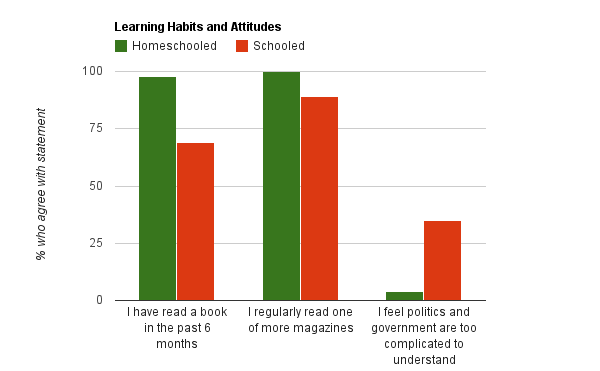
  • Learning habits and attitudes
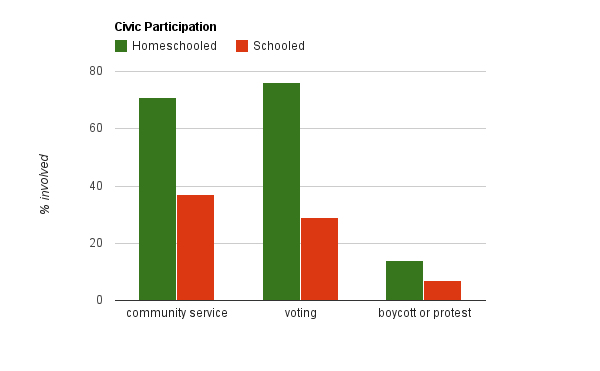
  • Civic Engagement
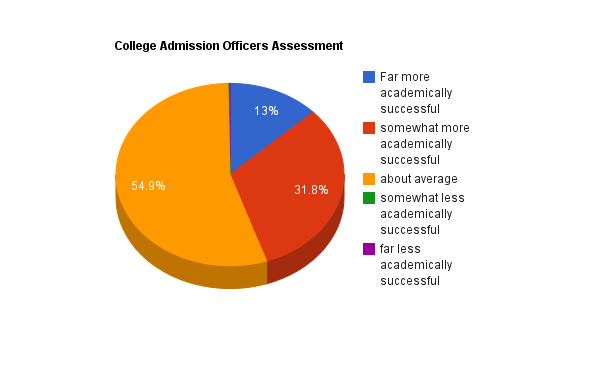
  • College Admission
Learning Habits
Participants were asked about their reading habits in relation to news, magazines and books.  Then they were asked about their level of confidence in following government issues.  The homeschooled adults were 30% more likely to have read a book in the previous six months and 10% more likely to regularly read a magazine.  When asked if they agreed with the statement “I feel politics and government are too complicated to understand” only 4% of homeschooled adults agreed compared to 35% of the general population.


Civic Engagement 
Participants were asked about their levels of civic engagement in select tasks.
  • homeschoolers almost twice as likely to be involved in regular community service
  • homeschoolers vote 60% more often than the general public
  • homeschoolers are twice as likely to have been involved in a boycott or protest


College Admissions  
The study looked at the perceptions of college admission officers on how homeschooled adults compared to traditionally schooled adults.   Zero respondents answered somewhat less or far less academically successful.  Overall just under 1/2 of the respondents deemed homeschooled applicants to be more academically successful than their traditionally schooled peers.

If you are or are considering opting out of a traditional school education, these are some facts that might help reassure you and others, that for the most part home educated kids are growing up to be above average adults.  Check out the entire study for details.
You have read this article DIY Learning / home education / home schooled / home schooling / unschooled / unschooling with the title home schooling. You can bookmark this page URL http://benncam.blogspot.com/2011/07/what-happens-to-home-educated-adults.html. Thanks!

A Compilation of work from John Holt - One of The Founders of the Home Education Movement

I have compiled the works of John Taylor Gatto and Ivan Illich, two people who are revered in the world of home education.  Historically, John Holt is arguably the most well-known when it comes to advocating and writing about home education.  Once a famous progressive teacher, he is ultimately credited as the founder of unschooling and one of the founders of the modern homeschooling movement. 

Here is a collection of some of his work.

John Holt (educator) - Wikipedia - Wikipedia provides a general overview of John Holt.  It might be a good place to get started.   

The Holt Associates Website - John Holt started Holt Associates in 1971 as a way to spread ideas and information about how children learn and how schools can be changed to create conditions that foster independent and group learning that are vastly different from the "teach 'em and test 'em" regime we force children into. Today, Holt Associates Inc. acts primarily as a trustee for the work and publications of John Holt. On the sight you’ll find the following resources:
  • Magazines:  You can access every issue of Growing Up Without School in the archives here at no cost.  I’ve talked to home educators who tell me stories of how they anxiously awaited the magazine each month.  Now you can read them on demand for free.  
  • Books:  Find a list of books published by John Holt and Holt Enterprises here.  
  • Reprints:  You can get reprints of John Holt’s writing for publications like Atalntic Monthly and Christian Science Monitor here.
  • Videos:  Here are videos of John Holt explaining how learning can be improved.  
  • Audio Recordings:  Listen to John Holt speak on radio programs and shows like NPR here.
Sandra Dodd’s John Holt page - Unschooling guru Sandra Dodd provides her insight into why she admired John Holt and his work and shares a collection of his writings, quotes and more.
You have read this article DIY Learning / home education / home schooled / home schooling / John Holt / unschooled / unschooling with the title home schooling. You can bookmark this page URL http://benncam.blogspot.com/2011/07/a-compilation-of-work-from-john-holt.html. Thanks!