Showing posts with label standardized tests. Show all posts

Common core ignores the power of the interests and ideas that come from our students and teachers - Deborah Meier

Editor’s note:  I feel fortunate to be living during a period in our history where for the first time we can easily form social learning circles that bring together from around the world, experts, authors, and others that share passions and can engage in rich and meaningful dialogue. The power of the technology to connect in ways never before possible is a game changer when it comes to learning. I have brought together one such amazing network of people who come together to think about and grapple with issues of ed reform and alternatives to the status quo with The Innovative Educator group.  Here is a piece of that learning where education icon Deborah Meier shares some of her thoughts on the common core.

Deborah Meier - Shares

Its a nice thought--that it [Common Core] is offering a "common language". I wish it were. But common core as presently understood is a 13 year mandatory curriculum (developed largely by experts in testing, not the subject matter being tested) of what is to be taught--and in what sequence. It ignores the power of the interests and ideas that come from students and teachers as the basis for forming curriculum"--or of picking up from the world around us our "curriculum". Starting "where we are" intellectually and moving out from there--a common approach to thematic studies, for example. Or spending months on one "small" part of history or science, in order to be able to ask deeper questions and make deeper sense--rather than covering" a lot in order to be prepared for shallow tests. (Uncovering vs covering as we sometimes say.) etc, etc.
In the schools I’ve worked in we were able to spend months on the Constitution (if we chose to) and thus less on other aspects of American history. We could focus long enough and deeply enough to engage in projects, to question the evidence, to weigh one source over another, to imagine other possibilities, to look for patterns, to acknowledge disagreements, etc, etc. We could return to last year's themes and subject matter as it cropped up gain in the context of this year. It enabled Mission Hill to study the same topics in all grades, Kgtn to 8th grade at the same time and thus turn the whole school community into a shared learning experience, and to lie out the idea that we're never "done", there is always more to learn about the same subject in new and different ways.

It also enabled us to give younger students the experience of watching older students and vice versa as they observed each other's work. It turned our hallways into lively places for common study, made it easier to have a wide range of books on the same topics, bring in experts from outside, and on and on. In all the schools I've worked in and with we've also been able to set aside time from the exploration of our private, personal passions and see where they took us individually or as a group. It meant, of course, a different way of assessing young people's work. What we developed instead was a "common" set of questions, habits of mind we called them, for getting at what we were trying to make sense of. It also meant that we spent two years covering "less" than one year's high school physics course. And on and on.

Reading The Power of Their Ideas or In Schools We Trust may give you some sense of what such a curriculum might look like. Or read an old book--36 Children by Herb Kohl. Suggestions, from others?

Deborah

Our conversations never die.  You can join in anytime here.  
You have read this article common core standards / common standards / deborah meier / standardized tests with the title standardized tests. You can bookmark this page URL http://benncam.blogspot.com/2012/10/common-core-ignores-power-of-interests.html. Thanks!

Alternatives to Standardized Tests for Homeschooling Families

Editor's note:  The information here targets homeschooling families, but these really are great ideas for all families.
Cross posted from Parent at the Helm with permission from Linda Dobson
homeschoolingFrom Susan and Larry Kaseman:
Your interest in your homeschooling child’s academic standing is understandable. Fortunately, we homeschooling families have many opportunities to observe our children’s development. We watch them exploring the world and, when necessary, translate what they do into conventional academic language. (Sorting rocks is science. Building with blocks is geometry and spatial relations. Recognizing one’s name is reading.) We can see the processes our children go through and support their early efforts just as we recognized and responded to their first words. We gradually come to understand that learning about baseball or horses develops basic academic skills.

Alternative Assessment for Worried Homeschooling Parents

When we get concerned about academics (yes, even confident, experienced homeschooling parents sometimes worry):
  • We can review what our children have already learned. What can they do today that they couldn’t do a few months ago? Write a note? discuss current political issues?
  • We can look at the big picture. As homeschooling parents, we know our children better than we would if they were attending a conventional school. We see their increasing understanding of the world; their growing ability to interact with others; their increasing self-reliance as they learn to ride a bike, drive a car, travel abroad; and their increasing maturity as they take responsibility for increasingly complex projects.
  • We can realize that to become mature, responsible adults, children don’t need to follow the path prescribed by conventional schools. Children learn best by following their own timetable, at different rates in different subjects. As homeschooling families, we have the flexibility to encourage this. Many grownup homeschoolers who are doing well didn’t learn to read until they were eight, ten, or older. Many who write well and are comfortable with math would earlier have been considered “below grade level.” Had they been pressured to learn these things earlier, they might have concluded that they could not learn them. A great gift we can give our children is the ability and courage to be true to themselves, to set their own standards, to identify problems and not be overwhelmed by them, to consider a wide range of alternative responses and then act. This will them well whether the problem is a car that won’t start, a health crisis, or simply the causes of the Civil War.
  • Perhaps the best preparation is the ability to learn new things. (Consider people now using computers who did not study them in school.) We can ask: Do our homeschooling children recognize when they don’t know something? Are they confident enough to admit that they don’t know it? Do our children know how to find information they need using resources such as their common sense, the library, the Internet, and assistance from other people?
  • Finally, it’s great that you want to avoid standardized tests. They interfere with learning and are inaccurate, unfair, and biased against minorities, women, and anyone who does not have the same experiences and values as the developer of the test. Taking a test often undermines self-esteem. Test scores show only how well a given person performed on a given test on a given day, not how much one knows.
But test results tend to be self-fulfilling prophecies. Why would we want to put our homeschooling children through difficult experiences that produce unreliable results that may be harmful to them?

The Hidden Lessons of Standardized Tests

Contributed by homeschooling veteran Ann Fisher

Standardized tests, in addition to being narrowly focused and frequently misused comparative measurements of academic progress, are powerful teachers in their own right. Are these the kinds of lessons you want your children to learn?
  • Someone else knows what I should know better than my parents or I do.
  • Learning is an absolute that can be measured.
  • My interests are not important enough to be measured.
  • The subject areas being evaluated on the test are the only things that are important to know.
  • Thinking is not valued; getting the “right” answer is the only goal.
  • The answer (to any question) is readily available and indisputable, and it’s one of these four or five answers here. There’s no need to look deeper or dwell on the question.
  • My worth can be summarized by a single mark on a paper.
  • The purpose of learning is to get a high score. High test scores are the only purpose of testing.
  • If I score very well, I am better than other people who do not score as well.
  • Poor test scores mean that I am a failure. If I score poorly, there is nothing I can do to change it. Why try?
  • I haven’t learned to read yet. I am not smart.
  • Since I am tested once a year so we can continue homeschooling, my parents and I have to spend the rest of the year preparing for the test.
  • The test was too hard. I am not smart.
  • The test was easy. I don’t have to learn any more.
  • The test was easy [hard]. Public [home] [private] school kids are dumber [smarter] than I am.
  • The questions on the test are what is important. What I have been studying is not important.
  • I have to get a higher score next year to show that I am learning.
For more information on the wonderful world of homeschooling, check out Linda Dobson’s The Homeschooling Book of Answers: The 101 Most Important Questions Answered by Homeschooling’s Most Respected Voices.

You have read this article homeschooling / standardized tests / unschool / unschooling with the title standardized tests. You can bookmark this page URL http://benncam.blogspot.com/2012/10/alternatives-to-standardized-tests-for.html. Thanks!

3 ways to measure students, teachers, & schools without standardized tests

A theme at this week’s Education Nation was the failure of standardized tests as a measurement of student achievement and teacher effectiveness. Those who know better know that standardized tests tell us more about a student’s language acquisition, parental involvement, poverty level, and developmental level than they do about teacher effectiveness or student ability. But, it is hard for anyone to imagine how we would possible assess student, teacher, and school effectiveness without the mindless drill, kill, bubblefill that forces students to memorize and regurgitate on demand.  Yet we all know these are not the skills that our students need for success in life.  

So how might we measure students, teachers, and schools if there were no tests? There are countless ways besides the mega-billion testing industry model, but here are three ideas for our policy makers like Mitt Romney who admit they don't know a better model than a testing system.


  1. Measure student achievement via authentic teacher assessment Teachers already have plenty of standardized measures of student growth. For example a teacher can do a running record to assess a child’s reading ability and measure their growth across the year.  We can assess a student’s authentic writing with standardized and normed writing rubrics. School systems like West Virginia are using these assessments.
  2. Measure teacher effectiveness via students and parent satisfaction Are the children happy and satisfied with teaching, learning, and relationships? Do parents feel involved? States like Rhode Island use these measures to assess schools and this research-based method is coming to more and more schools.
  3. Measure school effectiveness by ensuring students move on to college or career Measure what really matters. Employers and colleges know that good candidates are not produced as a result of forced memorization and regurgitation onto standardized tests. Hold schools accountable for ensuring students are prepared in ways that matter. This means each student moves on to the college, career, or an experience that aligns with their interests and goals. School models like Big Picture measure success and hold their schools accountable in this way.

Stay tuned to The Innovative Educator blog for more alternatives to standardized testing. Until then you might enjoy reading 9 Ways to Assess without Standardized Tests and Transform education by measuring what matters.
You have read this article Education Nation / standardized tests with the title standardized tests. You can bookmark this page URL http://benncam.blogspot.com/2012/09/3-ways-to-measure-students-teachers.html. Thanks!

Romney Promises Teen He Won't Back Down from High Stakes Tests

Nikhyl Goyal: Considering standardized testing has increased to historic levels causing a lot of teaching to the test, billions of dollars spent, and killing creativity, how would you as president change this trend? 

Mitt Romney: I don't have a better model than a testing system.
-------
And there ya have it.

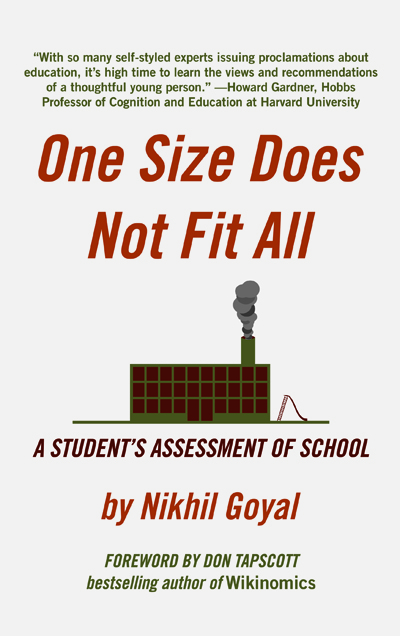
Nikhil Goyal, the teenage author of One Size Does Not Fit All, presented Mitt Romney with a hard-hitting question during NBC’s Education Nation exposing the presidential hopeful’s extreme ignorance when it comes to education policy.


Romney made a patronizing attempt at schooling the younger and wiser student but as he uttered each word of his response his ignorance on the topic became uncomfortably clear.

Romney explained it this way...

Lie
First he said...
“You will find throughout your life there are tests.”

Really?  For most Americans, tests (including the one for driving) occur while we are in school. Many of us have not had another test after high school.  Yes, some people choose to take a one-time certification test, but...
1) They are extremely rare in “life.”
2) They are taken by choice, not forced upon us.  

Ignorance
Then he said...
“I don’t know a way to evaluate progress without tests.” Yikes!!!! So Romney’s ignorance on more effective measures of assessment should guide our nation????

I wished the audience had chanted:


“Ask the kid!!! Ask the kid!!!!.” 

Hell, Mitt had an expert right in front of him and it didn’t occur to him to ask for advice.  But if asking the kid or reading his book is too much for Mitt, he could just think about how we evaluate progress in life? Spoiler alert: It almost never involves tests!!!!

Lie and Ignorance
And after that he said...
“There is no other way that we’ve found out to determine if a student is succeeding or not and no other way to find out if the teacher is succeeding or not.”
Really? Is he telling the teen (who’s much more knowledgable than him on the topic) that this is it?  This is the only way?  Of course, it’s a lie, but is Romney too stupid to know he is lying or is he lying and just thinking the rest of us are too stupid to figure it out?  

Lie
Then he explained that...
“When I was governor of Massachusetts I took the graduation exam which assesses basic math and everyone should know basic math.”
As he explained the tests he goes on to describe geometry, algebra, calculus as BASIC math!  Really? Many of us Americans get through life mighty fine without those fancy basic maths known as geometry, algebra, or calculus.  It's basic for those who wants to follow pursuits that require these subjects, but this is not basic and it is not necessary for success in life for their entire population.  

Ignorance
Romney explains that he passed the graduation test with an, “If I can do it, anyone can” grin.  
Within that grin is held complete ignorance of the realities that many of our students have.  No, they don’t have tutors.  No, they may not speak English.  Yes, they may have learning disabilities.  No, they may not have basic health care. Yes, they may not have parents. And...No, they may not have spent their lives in elite private schools or being homeschooled!

Avoidance / Ignorance
Romney completely ignored the part of Nikhil’s question about the billions of dollars being allocated toward testing.  Feh.  Billion, shmillion! Let’s move on.

Teacher Bashing Finale
Romney wanted to drive his point home to the questioning teen about his fear behind no having tests.  You know what that was????

We can’t trust dem teacher folk.

He said this:
“I was afraid before the tests that teachers would go off on a different tangent than the basic math, english, and science that our kids need to succeed.”

We need these tests or those teachers are gonna go off teaching some crazy irrelevant crap.  

But, wait! There’s more.
Romney concluded with his promise to the people.  There’s more where this came from!
He explained, that we won’t stop here! “I’ve added science so people will get tested in biology and geology and so forth.”

And, he concluded...
“Let’s make our testing more effective and expand it ways that haven’t even been thought of!”


Wink Wink to the mega-billion dollar testing industry that more is headed their way.
The sentence
Then he admitted...
“I don’t have a better model than to say we’re going to evaluate our kids through some kind of a testing system.”

So there ya have it folks.  Parents, your kids are gonna get tested and test prepped to death.  The presidential hopeful doesn’t have a better model and gosh dang it, reading Nikhil’s book or those blogs educator’s write just ain’t on his agenda.  

You can watch the video here.


Visit NBCNews.com for breaking news, world news, and news about the economy
You have read this article Education Nation / Mitt Romney / Nikhil Goyal / One Size Does Not Fit All / standardized tests with the title standardized tests. You can bookmark this page URL http://benncam.blogspot.com/2012/09/romney-promises-teen-he-won-back-down.html. Thanks!

Back to school reveals that we need to refocus on what matters for success

This American Life episode of Back to School questions what really matters when it comes to helping students find success and looks at what teachers can truly be responsible for.  Host Ira Glass asks are we really measuring the right thing and takes a look at if test scores really matter or do they just tell us what we already know.

Not surprisingly what Glass uncovers is that when we focus on test scores not only are we focusing on the wrong thing, but we are completely missing the boat when it comes to helping our students succeed who need it most. Need translates into youth living in poverty who do not have support at home and are being raised in an unstable and chaotic setting. Glass looks at how poverty-related stress affects brain development and provides a birds eye view from the perspective of a teenager who had this experience growing up. 

Experts like Paul Tough, author of the new book How Children Succeed, economist James Heckman, and doctor Nadine Burke Harris discuss more effective ways to meet the needs of school children and it doesn't have anything to do with test prep or scores.  Instead of viewing students as data points what we need is to help young people with the development of non-cognitive skills like tenacity, resilience, and impulse control.  Tough discusses research that suggest these skills can be learned and points to the success of various programs that revolve around early interventions both in the home and in school. Economist James Heckman then discusses they ways in which this shift in emphasis could change the way we practice education and the way we think about learning.

This is an important program for all those accountability, high-stakes testing nuts to pay attention to.  If you know one of them, send them a link to this show.
You have read this article back to school / boycott tests / standardized tests with the title standardized tests. You can bookmark this page URL http://benncam.blogspot.com/2012/09/back-to-school-reveals-that-we-need-to.html. Thanks!

Don't Occupy Wall Street. Occupy Schools.


All these people are out there at the one year anniversary of occupying Wall Street as if this is the reason they don't have jobs. Poor kids were duped into blaming and blocking what consists of a lot of average Joes putting in their 60 hours a week just doing what they know how to make a living. These protesters aren't occupying the real culprit behind the unfair economic system that benefits the rich and corporations at the expense of the rest of us...our public schools.

There is a clear and widening disconnect between what is happening in public schools and what young people need for success in the world. The reality is our nation has been sold a bad bill of goods. 

The "drill, kill, bubble fill" culture that is being rewarded today does not produce a suitable candidate for employment in our post industrial world. Even if our youth all march through a one-size-fits-all K-12 curriculum and go onto college, little has been done to foster the ability of young people to discover a livelihood best suited to their unique strengths, talents, and passions.


This is because every single kid is grouped by date of manufacture and expected to meet the same learning goals at the same time and pop out the same way at the other end with little to no attention focused on customizing a program to unique individuals. 

Instead they're served up a similar ration of English Language Arts (where work is rarely written for publication), math (which is rarely connected to the real world), social studies (that is rarely tied to social activism), and science (that rarely considers the environment in which children live).

At the end of the K-12 tunnel every kid emerges supposedly ready for college and career, but rarely have they had a chance to spend time focusing on what it is that "they" are passionate about. Instead they focus on earning the magic carrot of a grade and diploma rewarded to students who are best at memorization, regurgitation, and compliance along with following orders that we all know often are not in the best interest of children.

This system is of course not the one reserved for the children of the rich / corporations or the policy makers and politicians who send their children to the elite private schools that serve up a very different course selection which John Taylor Gatto so eloquently explains here and in part one of this series of videos.

As educators like John Merrow, Linda Darling-Hammon, Deb Meier, Diane Ravitch and most all of those who work in public schools have been trying to express, our corporate and politician-driven testing industry is at the core of the problem. It drives this dumbed down curriculum and severely punishes school leaders, teachers, parents, and our students who don't comply by shutting them down, firing them, threatening them, and leaving them behind.

Occupy Wall Streeters:  It's time to change direction. Charge forth toward schools and focus on the root of the problem.  Our students and teachers need your energy and insights. Find out the testing schedule in your school or district. Occupy those schools. Start an opt out brigade with a people's wall around that school protecting our public school students and staff from being subjected to these ineffective measures. 

You have nothing to lose but those in our public schools have everything to gain.
You have read this article boycott tests / occupy education / Occupy Wall Street / optout / standardized tests with the title standardized tests. You can bookmark this page URL http://benncam.blogspot.com/2012/09/don-occupy-wall-street-occupy-schools.html. Thanks!

Transform education by measuring what matters. Hint: It's not test scores.

There’s been a lot of talk about the ethics behind corporations running schools and thus profiting off students. But if we’re really concerned about folks profiting off our kids why aren’t we spending more time focusing on assessment? If we do away with measuring success with test scores the result would be billions saved that could go toward resources and personnel dedicated to support students.

Let’s face it: Teachers know and parents are waking up to the fact that these tests are one of the most expensive and least effective ways to measure student or teacher success. So why are we willing to let the government and policymakers forcibly impose this corporate-driven assessment from companies like Pearson upon our children even if it makes them sick???

What if instead we measured success in things that really mattered to students, parents and teachers.  

For example...

Students have:

  • A plan to find and develop their passion(s).
  • A team of mentors, guidance, and/or advisors to help guide them in discovery and development of their passions.
  • Customized success plans that they help design.
  • Advisors who are deeply involved in and responsible for their lives and their success.
  • An opportunity to learn about what they are interested in the world with real world experts.
  • Reported they are satisfied with support they receive from the school.
  • An authentic portfolio that can be used for career, academic, or civic pursuits.

Teachers and schools are measured by:

  • Success is moving students along to
    • Career
    • College and/or
    • Civic endeavors

that enable them to achieve their plans and goals for personal success.

Pie in the sky?

No.

The ability to do this, do it at scale, and report progress already exists.

Here’s how it works?

Primary Schools
For primary schools it works by incorporating the Schoolwide Enrichment Model and Total Talent Portfolio. In schools incorporating this model students and their teachers know they’ve got talent and they build upon students talents, interests, passions, ability and learning styles.  This method honors the idea that children are more than numbers and data. Instead they use Total Talent Portfolios to help them pursue engaging activities in areas of deep personal interest. The portfolio reveals that our children are unique individuals who are represented by much more than a number but instead what they have done with samples of real work and meaningful work that is not just handed in but worthy of the world. Visit this and this to see what this looks like in action..

Secondary Schools
See how this works for secondary students by checking out Dennis Littky and Elliot Washor’s Big Picture School model. As I reported earlier this year, these schools take on the responsibility of ensuring each student moves on to the college, career, or experience that aligns with their interests and goals and their teachers are evaluated on their ability to help make that happen.  

This is possible. It can be done. It is being done. It is the corporations that are getting in the way with infiltrating our schools with the multi-billion dollar testing industry that is good for politicians and good for business, but we all know this is not good for children and is robbing them of the very resources they need for success.

If we work to move the conversation to measuring success by meeting our student’s personal goals in college, career, and/or life experiences we accomplish these goals:
  • Instead of teaching to the test we teach to the student.
  • Billions of dollars are restored toward resources for students.
  • Schools are held accountable, not for test scores, but for placement in what matters: college, career, and/or civic duty.

Here are three things we can do about this.
  1. Demand this data from schools.
  2. Opt out of tests.
    • There is a group for doing so in every state on Facebook. Find it by searching “Opt out of standardized tests” followed by the name of your state.
  3. Talk to politicians about alternatives.

Let's stop celebrating test scores and accepting the status quo. Our children deserve to be more than a number. They deserve more than to be prepared to be compliant little beings who memorize, regurgitate and fill in bubbles on demand..OR ELSE! Parents and teachers must stand up for what matters for our children. The evidence is not one-size-fits-all tests. Instead let's honoring and recognizing the personalized success plans that are unique to each child and prepare them to move on to the college, career, and/or civic experience that will help them achieve their goals.
You have read this article boycott tests / education reform / personal success plan / standardized tests with the title standardized tests. You can bookmark this page URL http://benncam.blogspot.com/2012/08/transform-education-by-measuring-what.html. Thanks!

Here's what our standardized tests are really measuring. Shame!

Seth Godin does a great job of explaining why doing well on standardized tests does not a great nation make in this video.  


Listen as Godin explains how the founders of public school worked to preserve the interests of corporations (Andrew Carnegie) and government (Woodrow Wilson). Godin quickly outlines that to which those like John Taylor Gatto has devoted hundreds of pages. 

We needed public school for two reasons:
1) We were afraid we'd run out of good factory workers.
2) We were afraid we'd run out of folks who wanted to buy stuff.

So we created public schools to serve two purposes:
1) Train people to be compliant factory workers who were great at sitting in rows and following instructions.
2) We needed to teach people that if they wanted to fit in they needed to buy the stuff we told them to buy.

Our standardized tests measure our success in accomplishing these goals.
That's why people like Yong Zhao who heads Global Ed for University of Oregon explains countries like China are not proud when their students do well on these tests.  They know they kill innovation and creativity.  

Parents, teachers, administrators, do these test scores really make you proud?  If not, what will you do about it?
You have read this article boycott tests / seth godin / standardized tests with the title standardized tests. You can bookmark this page URL http://benncam.blogspot.com/2012/08/here-what-our-standardized-tests-are.html. Thanks!