Celine Azoulay - Making It Happen

One of the most influential members of personal learning network has been recognized today at NYSCATE with the International Society of Technology Educator's "Making IT Happen" award. This is an internationally recognized awards program for educators and leaders in the field of educational technology integration in K–12 schools. The program identifies and rewards educational technology leaders around the world for their commitment and innovation.

Recipients of the awards are educators who:

  1. Apply available technology now
  2. Move forward and don't look back
  3. See students as real people
  4. Teach through relationships, inspiring, encouraging, nurturing
  5. Recognize that further change is necessary, but understand that it is a process
  6. Realize that teacher empowerment is the key element to technology integration
  7. Expect success
  8. Motivate through awareness and access to information
It's no surprise that Celine Azoulay was presented with this award. Though the names, titles, and departments at the NYC DOE change often, what has remained the same is Celine Azoulay. Everyone who is anyone at the NYC DOE quickly discovers that Celine is the go to person when you want to make IT happen. I thank her for helping me and all those who share our passion to "Make IT Happen."
You have read this article Celine Azoulay / ISTE with the title . You can bookmark this page URL http://benncam.blogspot.com/2010/11/celine-azoulay-making-it-happen.html. Thanks!

Follow The Tweeter Who’s an Online Learning Leader - Top 200 Tweets from VSS2010

Listen to this article. Powered by  Odiogo.com
One of the best ways to get smart about any topic is by building your personal learning network through Twitter. Not only will you discover up-to-date information about a shared interest, you also develop a cadre of learning partners you can turn to when there’s something you need to know. During my recent foray into the world of online learning at iNacol’s Virtual Learning Symposium, I enjoyed my time in various sessions, but for me the real learning took place on Twitter where like-minded folks could discuss, real-time what they were learning and do so without disturbing anyone else. We were all tied together and found one another through the conference hashtag #vss2010.

Not only did I learn a lot from these Tweeps (people who Tweet) but after Tweeting out, “Anyone at #VSS2010 Heading to the airport for a 4:30 flight?” I even found someone with whom I could share a ride to the airport. Another fun Tweetcident (Twitter incident) occurred when I found myself in Twitosation (Twitter conversation) with a fellow attendee in reaction to disappointment in the commercialization of several presentations. We soon realized we were not only sitting in the same session but we were just seats apart from one another. How fun to be able to extend the Twitosation face-to-face.

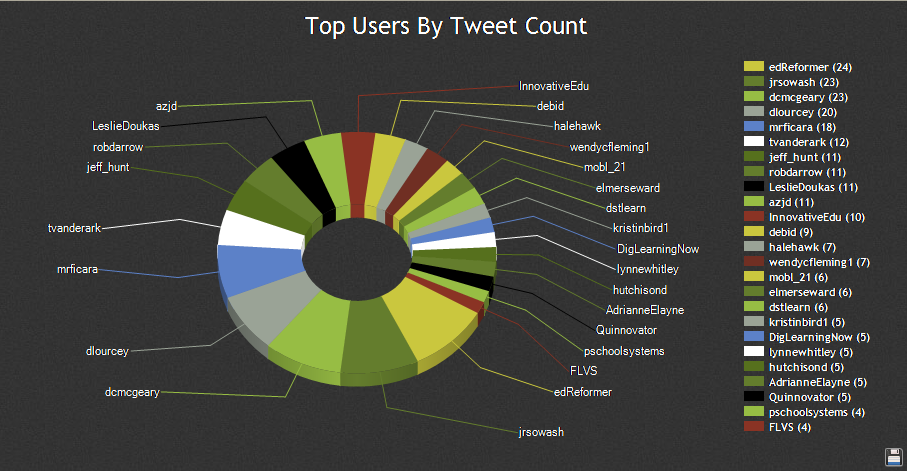
Innovative educators interested in connecting with others passionate about online learning can take a look at the chart below for a list of Tweeps interested in the topic. (Lookie! I’m top and center :-) If you click on the chart you’ll be taken to the source where you can just click on each person’s name and be brought directly to their Twitter account.

Below the chart you can see 200 Tweets I found worth highlighting sans those annoying commercials from the vendors (come on vendors, add some substance to your Tweets!)

Top 200 Tweets from iNacol’s Virtual School Symposium

Here are some interesting online learning Tweets shared at the conference. Find Tweeps you find interesting and connect with them by Tweeting using “@SelectedTwitter” i.e. “@innovativeedu. Your message will appear in their Twitter feed and the Twitosation begins!

Click here for the 200 Tweets.
You have read this article iNacol / online learning / vss2010 with the title . You can bookmark this page URL http://benncam.blogspot.com/2010/11/follow-tweeter-whos-online-learning.html. Thanks!

Educating Innovatively WITHOUT School

Editor’s note: This is the first in what I hope will be future guest posts by Kate Mende-Fridkis. Kate shares with innovative educators the perspective of a student who never attended a traditional K-12 setting. As she shares in her blog on the topic, she liked it.

We had “group,” which met every week or so—not for French lessons, but for random fun. The kids from group, local homeschoolers of different ages, went ice skating in the winter. We were the only ones on the rink, except for a foul-tempered skate guard with a bristling mustache. We went to parks in the summer. We built a raft out of recycling buckets and plywood and floated on the pond. We were not cool. Some of us ate processed cheese. No one had very much money.

The New York Times Style Magazine piece about trendy Brooklyn homeschoolers, School’s In, both did and didn’t remind me of my own pre-college education. My family called it unschooling, because we didn’t have any classes. My mother leaned a little more in the direction of the Brooklynites described in the article. She liked Kale. We weren’t allowed to watch television, and she grew a giant garden in the yard. But my best friend Emily, also homeschooled, ate sugary cereal and was allowed to watch TV. When I slept over her house, I was mesmerized by her depraved, thrilling lifestyle. Her Barbies had really big breasts. Mine weren’t really Barbies, and they were proportioned like real women.

Of course we ran into the Christian homeschoolers. They were always trying to save me. They always told me that until I stopped being so Jewish, I would go to hell. It was clear to me from a very young age that I couldn’t possibly represent “the movement.” The homeschooling movement, I mean. It was too diverse. But I tried. I was extra friendly to the adults who wanted to ask me lots of questions about whether or not I was learning anything, and whether or not I had any social skills at all.

The Brooklyn homeschoolers sound a little like my family and some of the homeschoolers I knew growing up. They emphasize art. My family did that. We emphasized music, mostly. But they also, ironically, remind me of the Waldorf schools, which they are apparently supposed to contrast with. The reporter describes the children’s fashionable outfits. They sport progressive first names like “Fiona” and “Theo.” They are in a class. Not a big class. But a class. With a paid teacher. My unschooling senses prickle. Paid?! A teacher?! When I was twelve or so, I liked to make fun of the Waldorf kids. By then we’d moved to the Princeton area, and Emily had gone to the Waldorf school down the street for what would turn out to be a brief stint. I said, “Now it’s time for our bread baking class! And after that we’re all going to draw a rose!” I thought this was hilarious. Silly hippies.

Even now (I’m twenty-four), people ask me what my days were like, as an unschooler. What did I do? How did I learn? And the truth is—I’m not exactly sure. Because they were almost never the same. There were some textbooks along the way. Maybe two. I was supposed to complete a certain amount of lessons a week from them. I did a lot of them on Fridays, when I remembered. I remember reading all the time. And writing all the time. And painting. And playing music. I did these things because I loved them. I loved them in a way that I sometimes think people have forgotten they can be loved by children and young adults. Because these activities weren’t school, or work, or homework, or a requirement. They were me. And when you love something enough to do it constantly, it will always lead to other things, and you will always get better at it. It sounds so simple. People want more of an answer. They want to know who my tutors were. What kind of education my mother had. Neither of my parents went to college. They started a business together as teenagers.

Both of my parents are very, very smart. They are both good at networking. They are both creative. But most importantly, in terms of my education, they both somehow were able to agree that I would turn out fine, even if I never sat in a classroom. They somehow trusted that children will always learn, as long as they are encouraged.

The Brooklyn homeschoolers’ world, as described, sounds so delicate to me. Which is funny, because people have always imagined my world to be constructed out of fragile materials and a rare brand of naive idealism. This is a narrative about homeschooling that people repeat. It’s not “real.” It’s sort of a fantasy. It’s not gritty and down to earth and diverse. Maybe this is always at least partly true, but, just as in a traditional school setting, it also just depends a lot on who is doing the homeschooling, or the unschooling.


Kate Fridkis blogs at Unschooled and is an editor at the Journal of Inter-Religious Dialogue. She recently received a Master's in Religion from Columbia University and is the lay cantor at Congregation Kehilat Shalom in central New Jersey.
You have read this article DIY Learning / home schooled / home schooling / homeschooled / unschooled / unschooling with the title . You can bookmark this page URL http://benncam.blogspot.com/2010/11/educating-innovatively-without-school.html. Thanks!