Showing posts with label Education Nation. Show all posts

Big news! Turns out it is okay if you don’t go to college.

Didja hear it?  If you were able to catch any of NBC’s Education Nation conversation, It was ever so subtle, but it was there. The part of the conversation that disturbingly has been the banned from the Common Core College and Career Readiness mantra.

If you heard it you noticed that the language is changing, slowly but surely, from the lips of the politicians, corporate funders, and even from the administrators who feel they must not deviate from the party line (even when they know it's wrong) lest they lose their jobs.

So, what's the big idea that is ever so softly slipping through the lips of those engaged in the politically correct education conversation?

The new and improved stats and facts have arrived, and....

College AND career readiness is OUTTA HERE!

In its place is an important conjunction that many of us were shut down and smacked down if we dared to utter those two ugly letters.

So what are the two little letters that could change everything?


OR

Yes, though it had been banned from the vocabulary of the Common Core proselytisers,  “OR” is now an acceptable word.

But, of course, there’s a condition.

It must be followed by post-secondary certification.  The whole phrase looks like this:

“College OR post-secondary certification and career readiness” and it's a step in the right direction.

Oh...all the documents where that popular CCR (college career readiness) acronym will need to be found and replaced with CPSCCR.  

But actually, we could fix that, because many of us know what would make it even better would be to simply remove the words "post-secondary" as many young people are capable of getting a certification during their teen years.

So perhaps the new language will be:

College or certification and career readiness.  

Or to make it a really nice acronym we could call it

College or certification and career competency.   

Then the acronym could just be  C4 or C4

What's more the pundits are acknowledging their fatally flawed claims about the success the earning power of those w/college degrees verses those w/out.  They can no longer deny the facts. When you account for socioeconomic status and student loan debt  the stats about earning potential of college grads frankly, puts a lot of money in the pockets of our government and our colleges, but it's a load of crap.

So, what will this mean?
  • It will mean that educators are allowed to publicly acknowledge that, "One size does not fit all!".
  • It will mean that we can consider and honor the passions of ALL students.
  • It will mean that we no longer have to send the message to those in our society who did not take the college path that you are less worthy than those who did.
  • It will mean that we can value the contributions of all and help them think about and seek out which of many options will help them achieve their path.

And, of course, let's not be naïve. There was also probably some big trade school association that funded studies and hired lobbyists to march on Capitol Hill rallying for their piece of the pie. These decisions most always follow the money. So get ready to see a lot more certification programs vying for their piece of the post-secondary education pie.  

But, still, that means more choices and that will mean better options for students and when all is said and done, that is what matters most.  

Next step of course is to realize the value of the on-the-job training and apprenticeship opportunities that made my close family members and friends (Director, Accountant, Computer Programmer, Sound Engineer) six-figure income earners without degrees or post-secondary certification programs. And, BONUS! No college debt or years of lost earnings while pursuing a degree.

Too often, our leaders view life through the narrow lens of when they were in a four-year college. A broader view is required to lead on this complex issue today.  The goal must not be for a one-size-fits-all path to success, but rather on providing a menu of options that may or may not include college or certification.
You have read this article college myth / common core standards / Education Nation with the title Education Nation. You can bookmark this page URL https://benncam.blogspot.com/2012/09/big-news-turns-out-it-is-okay-if-you.html. Thanks!

3 ways to measure students, teachers, & schools without standardized tests

A theme at this week’s Education Nation was the failure of standardized tests as a measurement of student achievement and teacher effectiveness. Those who know better know that standardized tests tell us more about a student’s language acquisition, parental involvement, poverty level, and developmental level than they do about teacher effectiveness or student ability. But, it is hard for anyone to imagine how we would possible assess student, teacher, and school effectiveness without the mindless drill, kill, bubblefill that forces students to memorize and regurgitate on demand.  Yet we all know these are not the skills that our students need for success in life.  

So how might we measure students, teachers, and schools if there were no tests? There are countless ways besides the mega-billion testing industry model, but here are three ideas for our policy makers like Mitt Romney who admit they don't know a better model than a testing system.


  1. Measure student achievement via authentic teacher assessment Teachers already have plenty of standardized measures of student growth. For example a teacher can do a running record to assess a child’s reading ability and measure their growth across the year.  We can assess a student’s authentic writing with standardized and normed writing rubrics. School systems like West Virginia are using these assessments.
  2. Measure teacher effectiveness via students and parent satisfaction Are the children happy and satisfied with teaching, learning, and relationships? Do parents feel involved? States like Rhode Island use these measures to assess schools and this research-based method is coming to more and more schools.
  3. Measure school effectiveness by ensuring students move on to college or career Measure what really matters. Employers and colleges know that good candidates are not produced as a result of forced memorization and regurgitation onto standardized tests. Hold schools accountable for ensuring students are prepared in ways that matter. This means each student moves on to the college, career, or an experience that aligns with their interests and goals. School models like Big Picture measure success and hold their schools accountable in this way.

Stay tuned to The Innovative Educator blog for more alternatives to standardized testing. Until then you might enjoy reading 9 Ways to Assess without Standardized Tests and Transform education by measuring what matters.
You have read this article Education Nation / standardized tests with the title Education Nation. You can bookmark this page URL https://benncam.blogspot.com/2012/09/3-ways-to-measure-students-teachers.html. Thanks!

Romney Promises Teen He Won't Back Down from High Stakes Tests

Nikhyl Goyal: Considering standardized testing has increased to historic levels causing a lot of teaching to the test, billions of dollars spent, and killing creativity, how would you as president change this trend

Mitt Romney: I don't have a better model than a testing system.
-------
And there ya have it.

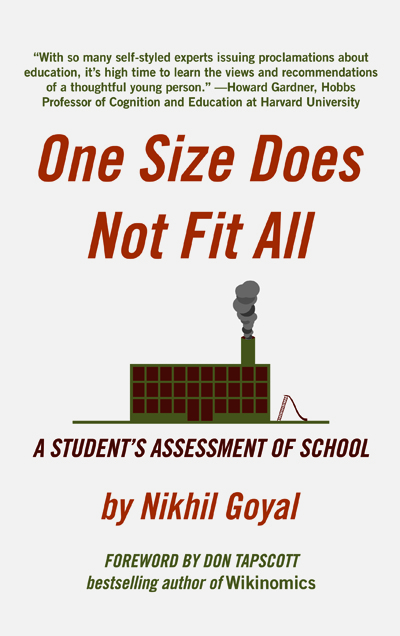
Nikhil Goyal, the teenage author of One Size Does Not Fit All, presented Mitt Romney with a hard-hitting question during NBC’s Education Nation exposing the presidential hopeful’s extreme ignorance when it comes to education policy.


Romney made a patronizing attempt at schooling the younger and wiser student but as he uttered each word of his response his ignorance on the topic became uncomfortably clear.

Romney explained it this way...

Lie
First he said...
“You will find throughout your life there are tests.”

Really?  For most Americans, tests (including the one for driving) occur while we are in school. Many of us have not had another test after high school.  Yes, some people choose to take a one-time certification test, but...
1) They are extremely rare in “life.”
2) They are taken by choice, not forced upon us.  

Ignorance
Then he said...
“I don’t know a way to evaluate progress without tests.” Yikes!!!! So Romney’s ignorance on more effective measures of assessment should guide our nation????

I wished the audience had chanted:


“Ask the kid!!! Ask the kid!!!!.” 

Hell, Mitt had an expert right in front of him and it didn’t occur to him to ask for advice.  But if asking the kid or reading his book is too much for Mitt, he could just think about how we evaluate progress in life? Spoiler alert: It almost never involves tests!!!!

Lie and Ignorance
And after that he said...
“There is no other way that we’ve found out to determine if a student is succeeding or not and no other way to find out if the teacher is succeeding or not.”
Really? Is he telling the teen (who’s much more knowledgable than him on the topic) that this is it?  This is the only way?  Of course, it’s a lie, but is Romney too stupid to know he is lying or is he lying and just thinking the rest of us are too stupid to figure it out?  

Lie
Then he explained that...
“When I was governor of Massachusetts I took the graduation exam which assesses basic math and everyone should know basic math.”
As he explained the tests he goes on to describe geometry, algebra, calculus as BASIC math!  Really? Many of us Americans get through life mighty fine without those fancy basic maths known as geometry, algebra, or calculus.  It's basic for those who wants to follow pursuits that require these subjects, but this is not basic and it is not necessary for success in life for their entire population.  

Ignorance
Romney explains that he passed the graduation test with an, “If I can do it, anyone can” grin.  
Within that grin is held complete ignorance of the realities that many of our students have.  No, they don’t have tutors.  No, they may not speak English.  Yes, they may have learning disabilities.  No, they may not have basic health care. Yes, they may not have parents. And...No, they may not have spent their lives in elite private schools or being homeschooled!

Avoidance / Ignorance
Romney completely ignored the part of Nikhil’s question about the billions of dollars being allocated toward testing.  Feh.  Billion, shmillion! Let’s move on.

Teacher Bashing Finale
Romney wanted to drive his point home to the questioning teen about his fear behind no having tests.  You know what that was????

We can’t trust dem teacher folk.

He said this:
“I was afraid before the tests that teachers would go off on a different tangent than the basic math, english, and science that our kids need to succeed.”

We need these tests or those teachers are gonna go off teaching some crazy irrelevant crap.  

But, wait! There’s more.
Romney concluded with his promise to the people.  There’s more where this came from!
He explained, that we won’t stop here! “I’ve added science so people will get tested in biology and geology and so forth.”

And, he concluded...
“Let’s make our testing more effective and expand it ways that haven’t even been thought of!”


Wink Wink to the mega-billion dollar testing industry that more is headed their way.
The sentence
Then he admitted...
“I don’t have a better model than to say we’re going to evaluate our kids through some kind of a testing system.”

So there ya have it folks.  Parents, your kids are gonna get tested and test prepped to death.  The presidential hopeful doesn’t have a better model and gosh dang it, reading Nikhil’s book or those blogs educator’s write just ain’t on his agenda.  

You can watch the video here.


Visit NBCNews.com for breaking news, world news, and news about the economy
You have read this article Education Nation / Mitt Romney / Nikhil Goyal / One Size Does Not Fit All / standardized tests with the title Education Nation. You can bookmark this page URL https://benncam.blogspot.com/2012/09/romney-promises-teen-he-won-back-down.html. Thanks!

Reflect on Education Nation’s Student Town Hall During Tonight’s Student Voice Webinar


"When the student voice awakens, the national conversation will change." -Diane Ravitch

Viewers of Education Nation’s Student Town Hall watched students from across the country attend and speak up to share their ideas. Tonight during a special webinar, participants will have a chance to connect with those who attended the conference to respond to and discuss their perspectives and solutions to the issues explored at the event.

You can join students, parents, teachers and others to reflect upon and discuss what happened during NBC’s Education Nation Student Town Hall today, September 24 at 9 pm EST. The webinar will give participants the opportunity to reflect on the Town Hall and discuss what can be done to enhance and empower the student voice nationwide.

Participants will have an opportunity to engage in a stimulating dialogue where they can respond to the panelists’ remarks and discuss how we can continue to elevate the student voice in our communities and on a national stage.

This personalized, solutions-driven webinar will provide a platform for students, parents, educators, and anyone interested to unite in a collaborative effort to not only give students a voice, but also a seat at the table in education policy discussions.

Be a part of the solution and join this webinar on Monday evening from 9 pm to 10 pm EST. You can participate by visiting this link.  

Student Voice
Student Voice is a grassroots organization that works to unite and elevate the student voice. This support network serves to aid and empower students in their efforts to be heard and earn their rightful seat at the table.

Keep the conversation going.
You can keep the conversation going with #StuVoice chats (hosted by StuVoice.org) on Mondays at 8:30 EST, with weekly topics that focus on enhancing and empowering the student voice nationwide.

You have read this article #stuvoice / Education Nation / Student voice with the title Education Nation. You can bookmark this page URL https://benncam.blogspot.com/2012/09/reflect-on-education-nations-student.html. Thanks!

NBC’s Education Nation puts the spotlight on students


Education policy is an ever-polarizing issue where students, the real victims of the system’s failures, are often ignored or entirely forgotten.

NBC's Education Nation is putting the focus where it belongs and amplifying the voice of education’s most important constituents, the students, with the broadcast of its first-ever Student Town Hall on a special edition of MSNBC’s Melissa Harris-Perry Show.

Harris-Perry’s believes this is an important conversation to have sharing that, “Far too often we talk ‘about’ young people without bothering to talk ‘to’ young people. Students know what inspires them, what challenges them, what impedes their progress and what facilitates their learning. We cannot have a fully informed conversation about education reform, without the perspective of students themselves.”

The esteemed panel includes high school student, 17-year-old Nikhil Goyal, who is the author of One Size Does Not Fit All: A Student Assessment of School.   

Viewing details
Tune in to NBC today, Sunday, September 23 from 10 a.m. to 12 p.m. EST to hear students from across the country sharing their ideas about education and how it will effect their future. Viewers can share their insights, solutions, and expand the dialogue that arises during the program using both the #StuVoice and #EdNatSTH hashtags on Twitter.  

Student Voice
Student Voice is a grassroots organization that works to unite and elevate the student voice. This support network serves to aid and empower students in their efforts to be heard and earn their rightful seat at the table.

Keep the conversation going.
You can keep the conversation going with #StuVoice chats (hosted by StuVoice.org) on Mondays at 8:30 EST, with weekly topics that focus on enhancing and empowering the student voice nationwide.

You have read this article Education Nation / Student voice with the title Education Nation. You can bookmark this page URL https://benncam.blogspot.com/2012/09/nbcs-education-nation-puts-spotlight-on.html. Thanks!

20 Things Students Want the Nation to Know About Education


It's rare for education reformers, policymakers, and funders to listen to those at the heart of education reform work: The students. In fact Ann Curry who hosted Education Nation's first *student panel admitted folks at NBC were a little nervous about putting kids on stage. In their "Voices of a Nation" discussion, young people provided insight into their own experiences with education and what they think needs to be done to ensure that every student receives a world-class education. After the discussion Curry knew these students didn't disappoint. She told viewers, "Students wanted to say something that made a difference to you (adults) and they did. Now adults need to listen."

Here is a video of the student panelists followed by a recap of some of the sentiments they shared.

Visit msnbc.com for breaking news, world news, and news about the economy


Below are the sentiments shared by these current and former students during the segment.
  1. I have to critically think in college, but your tests don't teach me that.
  2. We learn in different ways at different rates.
  3. I can't learn from you if you are not willing to connect with me.
  4. Teaching by the book is not teaching. It's just talking.
  5. Caring about each student is more important than teaching the class.
  6. Every young person has a dream. Your job is to help bring us closer to our dreams.
  7. We need more than teachers. We need life coaches.
  8. The community should become more involved in schools.
  9. Even if you don't want to be a teacher, you can offer a student an apprenticeship.
  10. Us youth love all the new technologies that come out. When you acknowledge this and use technology in your teaching it makes learning much more interesting.
  11. You should be trained not just in teaching but also in counseling.
  12. Tell me something good that I'm doing so that I can keep growing in that.
  13. When you can feel like a family member it helps so much.
  14. We appreciate when you connect with us in our worlds such as the teacher who provided us with extra help using Xbox and Skype
  15. Our teachers have too many students to enable them to connect with us in they way we need them to.
  16. Bring the electives that we are actually interested in back to school. Things like drama, art, cooking, music.
  17. Education leaders, teachers, funders, and policy makers need to start listening to student voice in all areas including teacher evaluations.
  18. You need to use tools in the classroom that we use in the real world like Facebook, email, and other tools we use to connect and communicate.
  19. You need to love a student before you can teach a student.
  20. We do tests to make teachers look good and the school look good, but we know they don't help us to learn what's important to us.
The students are ready to talk to us.  How are we going to make time to listen and incorporate their voices into the policies and decisions that affect them?

*Panelists:
Nnamdi Asomugha, Cornerback - Philadelphia Eagles
Shadrack Boayke - Brentwook, NY
Colton Bradford - Mobile, AL
Ron Daldine - Auburn Hills, MI
Rayla Gaddy - Detroit, MI
Katie Oliveria - Las Vegas, NV
Stephanie Torres - New York, NY

The people tweeting about student voice at Education Nation.
You have read this article Education Nation / Student voice with the title Education Nation. You can bookmark this page URL https://benncam.blogspot.com/2011/09/20-things-students-want-nation-to-know.html. Thanks!

Mayor Bloomberg Announces to Millions that Innovation in Education is One of His Key Initiatives

Despite some of the disappointment in the agenda at the Education Nation Summit, there was a ray of light that I’m optimistic about. At the Summit Mayor Bloomberg announced the launch of a project I’m thrilled to have been involved in since last year called the iZone. The fact that real innovation is on the forefront of the mind of the mayor of the biggest city in the U.S. is promising. What is more promising is that he doesn’t see innovation as simply data driven assessment, but as actually incorporating true innovative ideas into New York City schools.

His announcement follows the official kickoff of the iZone which I had the privilege of attending in person where Chancellor Joel Klein addressed over 100 iZone partners, including principals and teachers from the 80+ participating schools, to mark the beginning of this transformative initiative.

One area I’m excited about is the move toward online learning and virtual schooling. Another is the move away from traditional seat time requirements and toward mastery demonstration that allows students to move through courses at their speed and in different ways. I was also thrilled to learn that Bloomberg is pushing for the abolishment of an old State law that requires schools to buy printed textbooks rather than the digital content. He notes that may be good business for the textbook industry, but it really is a bad deal for our students in this day and age. I’ve been talking about the long over-due demise of the textbook for years. It’s exciting to see the Mayor is behind moving into the digital age providing for more meaningful and engaging content for our students.

The iZone was developed to ensure students are better prepared for college and careers by challenging longstanding assumptions around “business as usual” in K-12 education. The Mayor highlighted the iZone as one of his key priorities for the next three years. You can watch the video here.


You can get involved by visiting the iZone site and clicking here where you can enter your email to receive tailored updates and notifications around new activity within the iZone.
You have read this article Education Nation / iZone / Mayor Bloomberg with the title Education Nation. You can bookmark this page URL https://benncam.blogspot.com/2010/09/mayor-bloomberg-announces-to-millions.html. Thanks!

Innovation is Finally in the NYC Education Conversation

I’ve been working in education more than a decade having to work on the DL to sneak innovation into the classrooms and schools in the name of taking the risks that our students need for success. In a system of banning, filtering and outdated mandates, I’ve been morally compelled to sneak in, break in, and secretly help teachers and myself prepare students for real-world success. Unfortunately, for much of my career, my idea of innovation and preparation did not match with the powers that be who saw success couched in standardized tests that make testing companies richer and can affect the success of a politician, but do a horrible job of actually doing what they are touted to do. Assess student and school success.

It seems, New York City is now moving in the right direction. Mayor Bloomberg addressed NBC's Education Nation Summit outlining his education priorities for the next few years. I’m finally psyched to be a part of the educational vision and priorities of my district. Bloomberg outlined a four step plan which you can read in full here.

What I’m most excited about is the city’s strategy for supporting kids for career and college readiness. This involves fundamentally redesigning classroom learning. Bloomberg describes this as follows. “By empowering teachers to use cutting edge technology, we’ll help them tailor lesson plans around the individual learning needs of students – and give every student more personal attention.”

He adds, “Our work to connect students to college and careers, is nothing short of revolutionary. Imagine, for a minute, looking into a classroom, and instead of seeing some kids raising their hands to every question, and others just daydreaming, you see a small group working with a teacher in one corner, other kids working individually on their portable computers, and other kids working together on the same project, online.”
  • I’d like to add to this and take the learning out of just school walls and inside traditional building hours, but it’s definitely progress.
He also shares that “Everywhere you go in this school, rather than lecturing at students as a class, teachers will be working with students as individuals or small teams on projects and lessons specifically tailored to their own learning styles and needs.”
  • To this I’d like to add that as scary as it is for some to let go of tradition, I hope we learn to dispel the myth of the traditional teacher owning this role. Bringing teachers who are experts into the learning from the community and across the globe via the internet is impactful and oft times these experts may themselves be students. This also means, at time that time or place are unnecessary constraints when speaking of global connections and that students escape the walls of school to tap into community resources for local connections.
Bloomberg explains that “those scenes are playing out more and more every single school day here in New York City I’m happy to say. We’ve created 80 Innovation Schools that have started down the ground-breaking path of using technology to design individual learning plans for each child. In an iPad world, our students shouldn’t be stuck looking at overhead projectors. With funding help from our State, we can make every single school in New York City ready for this high-tech program, and we can work with teachers to transform 400 of our schools into Innovation Schools over the next three years. But to make them fully functional, we’ll also need the State to take two other steps.
  • These next two steps are exciting news and something myself and colleagues have been pushing for passionately for years including last week in Albany. How exciting to hear this come from the mayor:
“First, an old State law requires schools to buy printed textbooks rather than the digital content. That may be good business for the textbook industry, but it really is a bad deal for our students in this day and age. Second, we’ll work with the State to end what is called ‘seat time,’ which requires that all students spend a certain number of hours in their seats on every subject – even if they’ve already learned what’s expected of them.”
  • All I can say is, “Hear! Hear!!!!”
Bloomberg asked, “What if Maria has mastered 10th grade biology by April, instead of June? Why not let her jump-start on chemistry? Technology can empower our teachers and students – and we must take advantage of it.”
  • Agree! Grouping students by what Sir Ken Robinson has dubbed as “date of manufacture” really makes no sense at all. Let’s group students by talents, passions, interests, and abilities. Students are age grouped in life? Squashing this artificial construct is long overdue!
“The 400 Innovation schools we are planning reflect our determination to give parents more top-quality school choices – and that’s our fourth and final strategy for connecting students to college and careers.”
You have read this article #educationnation / Education Nation / Mayor Bloomberg with the title Education Nation. You can bookmark this page URL https://benncam.blogspot.com/2010/09/innovation-is-finally-in-nyc-education.html. Thanks!

Keep the Education Conversation Going on Twitter with #EdChat Even After the Hype

Education Nation, Waiting for Superman, Mark Zuckerberg Announces on Oprah He’ll Donate $100 Million to Newark Public Schools...

It seems like suddenly everyone’s talking about education and that’s great, but once hoopla dies down, how do we keep the conversation going? Answer: Twitter provides an excellent platform. When I speak to educators about why it’s important for educators to use Twitter, I start by explaining it’s really all about the conversation and connections. In fact, I had this conversation today with some high profile educators who I was trying to convince to get more involved in social media. They share the sentiment that, “If I want to converse, I’ll talk to my colleagues.” The problem with this is that 1) They may not be interested in or feel like talking about the same thing you do, when you do and 2) A conversation with the same few people might not provide the richest experience.

Twitter solves the issue by providing global connections with those passionate about the same topics you are and if education is your passion, then #edchat is a conversation you should join. “Ed Chat,” or as we call it in the Twitosphere, #edchat is a terrific way for educators to join the education conversation on an ongoing basis. It enables educators all over the world to participate in online discussions that take the form of a fast-paced chat room on Twitter about important educational topics such as, “How can we teach our students about their digital footprint and maintain a positive one ourselves?” The discussion centers around the selected topic, with people posing questions, responding to each other and retweeting statements, questions or ideas that they like. Participants tag their tweets with #edchat so that anyone can follow the conversation. (Thanks to @MBTeach for this description on her blog.)

The #edchat wiki describes it this way.

Open, collaborative, focused discussion can open and expand minds. But let's not stop there- let's harness this wisdom of the many to crowdsource possible solutions to some of the major issues that are uncovered...


Here is a video overview of #Edchat


Here is how you can participate.
  • When does #edchat take place? There are two edchat discussions which take place at 12pm and 7pm NYT (EST).
  • How are Topics Chosen? Every Monday, Tom Whitby, Steven Anderson, and ShellTerrell create a twtpoll of 5 topics to choose from for Tuesday’s discussion. You can vote in the poll by visiting http://twtpoll.com and searching #edchat. You may also propose topics by sending us a Tweet or DM to Tom, Steve, or Shelly!
  • What is a hashtag? Check out this video to discover what a hashtag is and how to use a hashtag. Every Tuesday, at the designated time, you only need to add “#edchat” to the end of your tweet to participate in the discussion.
So what is so special about #edchat?
Participant & moderator Mary Beth Hertz provides this insightful overview explaining why educators find #edchat so useful sharing this.

I find the fast pace discussion exciting. The varied opinions and points of view are enlightening, and the discussion is always deep and meaningful. Some might think of it as organized chaos, but it is just like sitting in a room of brilliant educators and never having to move around the room to hear everyone's conversations. What's even better, you can jump in at any time when you see a topic, statement or idea that grabs you or that you feel strongly about without feeling like you're interrupting a conversation.

The #edchat discussions are also a great place to find like-minded educators to add to your PLN (Personal or Professional Learning Network). Often, after a session, you will find your email inbox full of people from the chat who found you on Twitter, and you can search them out as well to follow.

Get Going with #EdChat today
You can get started today, or any Tuesday by logging onto Twitter at noon or 7 p.m. EST and using your preferred tool like Twitter Search, Twitterfall, TweetDeck or HootSuite, Twhirl or TweetGrid to follow and engage in the conversation and visit Twtpoll to check out the conversation topic.


Related posts
You have read this article #edchat / Education Nation / Mark Zuckerberg / twitter / Twitter in Education / Waiting for Superman with the title Education Nation. You can bookmark this page URL https://benncam.blogspot.com/2010/09/keep-education-conversation-going-on.html. Thanks!