Showing posts with label TIE. Show all posts

Six Reasons I’m excited about homeschooling my future children

(A post from Kate Fridkis, of Skipping School and Eat the Damn Cake)


I grew up without school and my husband grew up with school. I’m twenty-five, and Bear is twenty-six, and sometimes we sit around and talk about the kids we might have someday, because we’re not at all cool, and don’t get invited to any parties. I’m kidding. We get invited to (tons of amazing) parties. And we also talk about our future kids and how they will learn, and what kind of lives they will have. We can make a pretty good case for homeschooling. It may or may not involve a boat. 

Here are a few reasons why homeschooling our future kids will be awesome:

1) We can live anywhere
And then we can move and not worry about the new schools.


2) We won’t have to have the public/private debate
And end up worrying that our kids aren’t in the most advantageous environment if we choose public or that we don’t have any money left if we choose private.


3) We can travel as a family, and it can count as schooling
Maybe we can do this on a boat. Boats sound nice in my fantasies. There was that family a while back who sailed around together for a year, and the mom wrote a book about it (of course). I can’t imagine this working very well when I was a kid, because of my brothers. They chased each other around the house a lot. And then the house felt small, even though it was a house. But maybe I’ll have quieter kids. Bear is pretty quiet. And calm. And low key. I’m really, really hoping our kids turn out just like him and practically nothing like me. I also hope they get his nose, because it’s adorable.


(I googled “boat” and got this. Amazing. source)

I was imagining something more like this: (source)

4) My kids can play outside a lot.
Playing outside is like the archetypal thing that future parents imagine their wholesome children doing. So it sounds pretty corny. But it really is great, when you get down to it. I played in a stream for a lot of my childhood. It was amazing. Really. I had so many adventures in that stream. I was so proud of that stream. When it dried up in the dead of summer, I was embarrassed for both of us. It looked so naked and sad and had so obviously failed, and it was mine. When there was a brief flood that caused panic among sheltered New Jersey adults, I snuck outside and forded my raging river stream, bursting with pride and excitement. Dad was very upset when he discovered that I was gone. He was also very upset when I came back, and he got to tell me how upset he’d been.

Maybe my children won’t fall in love with a stream, but I’d like to at least give them the opportunity to do a lot of fun stuff outside.



5) My kids can mess up without it being a big deal.
They can try to learn a really difficult language and then decide they’d rather learn a different one and they can switch over without getting anything on their record. They can get all of the math problems wrong until they get them right, and it won’t even matter. Actually, it’ll just be nice for them not to have records.


6) My kids can hang out with each other.
My readers know how much I love my brothers. Can’t live without those guys. And it’s always been that way. My non-schooled friends have pretty much always been friends with their siblings. And I’ve been friends with their siblings, too. People came in families, not alone. We all belong to our families, whether or not we like it.



Bear and I are in California this week, visiting his family. Sometimes it’s a little heartbreaking, to be on opposite coasts. I wonder how we’ll make it work. I wonder who we’ll have to choose– mine or his. I wonder where our kids will grow up, and which set of grandparents they’ll grow close with. You’re not supposed to put it like that. You’re supposed to say “they’ll be close with both, for different reasons” or something. But it’s much easier to be close with someone you see. Someone you spend more time around. Growing up, I had a primary and a secondary set of grandparents. That’s just the way it works sometimes.


And I don’t want it to work that way for Bear and me and our future children. I want both. I want everything.


My dad says, “That’s not the way life works,” sometimes. He tells me that people settle down. They make certain choices. They build a home.


I think, “People don’t always have to do the thing that people always do.”
I think about spending winters and springs there, summers and falls here. I think about how else it might work. And then I think about how I will homeschool my kids, and I feel relieved. The imaginary structure of my hypothetical future is flexible. 


There may eventually even be room for a boat trip. Who knows.

You have read this article alternative education / DIY Learning / homeschooling / kate fridkis / skipping school / TIE / un-schooled / unschooling with the title TIE. You can bookmark this page URL https://benncam.blogspot.com/2011/05/six-reasons-im-excited-about.html. Thanks!

Superwoman Was Already Here

By Daniel C. Petter-Lipstein. This post originally appeared on Kate Fridkis's blog Un-schooled.

Superwoman was already here.

And she gave us a superb educational model to end the “Race to Nowhere.”

Her name was Dr. Maria Montessori and in the first half of the 20th century she pioneered and refined the Montessori method of education. Today, there are over 17,000 Montessori schools worldwide including thousands of preschools in the USA and hundreds of Montessori schools in the U.S. at the K-8 level.

My children go to a private Jewish Montessori school in New Jersey called Yeshivat Netivot Montessori. After five years as a parent at Netivot, I now believe quite deeply that it is a national tragedy that Montessori is largely deemed to be an educational option only for privileged kids from families that can afford tuition at a progressive private school.

Millions more American children deserve access to a Montessori education.

There are about 350 public Montessori schools in the United States, a number that is shamefully small.

I am not writing to explain, “What is Montessori?” There are several good books, lots of internet videos and numerous websites to answer that question.

But I do want to offer three reasons* Why I love Montessori and believe that millions more American children could benefit from this extraordinary approach to teaching and learning:

1. Curiosity

In a Montessori classroom, questions matter more than answers and a child’s natural curiosity is welcomed, not shunned.

Newsweek ran an article last summer about America’s “creativity crisis” with this striking paragraph (emphasis mine):

“Preschool children, on average, ask their parents about 100 questions a day. Why, why, why—sometimes parents just wish it’d stop. Tragically, it does stop. By middle school they’ve pretty much stopped asking. It’s no coincidence that this same time is when student motivation and engagement plummet. They didn’t stop asking questions because they lost interest: it’s the other way around. They lost interest because they stopped asking questions.

(some kids getting all Montessori with shapes. source)

In a Montessori school, this dynamic does not happen because teachers “follow the child” and are always encouraging the kids to ask questions. The Montessori method cares far more about the inquiry process and less about the results of those inquiries, believing that children will eventually master–with the guidance of their teachers and the engaged use of the hands-on Montessori materials which control for error–the expected answers and results that are the focus of most traditional classroom activity.

My daughter’s lower elementary teacher (Montessori classes are typically multi-age, lower elementary is grades 1-3 together) recently told me that a few kids in her classroom were learning about the triangle and they asked “Can a triangle have more or less than 180 degrees?” In classic Montessori style, the teacher turned the question back on them and said, “Use the hands-on geometric materials and try and make an actual triangle that is more or less than 180 degrees.” So the children have their question honored and arrive at the proper answer by themselves.

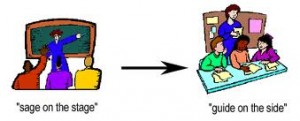
This story also highlights the role of a teacher in a Montessori classroom as being a “guide on the side” rather than the “sage on the stage.”

(can you believe that I found this on the internet? source)

In a world where the amount of information is doubling every 2.5 years (with much of it available at the click of a mouse) and where the top 10 in-demand jobs in 2010 did not even exist in 2004, encouraging kids to ask good questions and giving them life-long tools to investigate those questions is far more important than instructing them on how to produce correct responses. Even if those answers require some level of complexity, they are generally still straight-forward and predictable, which hardly prepares them for a world whose path is increasingly winding and unknown.

The culture of inquiry that is the hallmark of a good Montessori school is also a critical foundation for the creativity and innovation that America will need to compete in the 21st century. In December 2009, the Harvard Business Review published an article called, “The Innovator’s DNA” based on a six-year study of 3,000 creative executives including visionaries likeApple’s Steve Jobs, Amazon’s Jeff Bezos, Ebay’s Pierre Omidyar and Meg Whitman, and P&G’s A.G. Lafley. In an accompanying interview (with two of the three authors of the study) entitled How Do Innovators Think?”, one of the professors that conducted the study noted (emphasis mine)

“We also believe that the most innovative entrepreneurs were very lucky to have been raised in an atmosphere where inquisitiveness was encouraged. We were struck by the stories they told about being sustained by people who cared about experimentation and exploration. Sometimes these people were relatives, but sometimes they were neighbors, teachers or other influential adults. A number of the innovative entrepreneurs also went to Montessori schools, where they learned to follow their curiosity. To paraphrase the famous Apple ad campaign, innovators not only learned early on to think different, they act different (and even talk different).”

2. No Homework

(source)

Many parents ask themselves, “If my child is spending six, seven or eight hours in school, why does she get so much homework?” If she were alive today, Dr. Maria Montessori would definitely be asking the same question.

My children do not have any daily homework at their Montessori school. While this varies at Montessori schools, most Montessori schools do not give kids any kind of daily homework. They may have research projects or long-term book reports (as do the students at my daughters’ Jewish Montessori school), but no daily homework.

The effectiveness of the Montessori approach usually obviates the need for homework. As one father in our school noted to me, “My 7 year-old was in a traditional school last year and he learns more in a day at this Montessori school than he did in a month at his regular school.” Since children in a high-quality Montessori school learn mostly by doing and by using as many of their senses as possible, in-school time is extremely productive and there is little or no requirement for homework to review and/or build upon their daily in-school lessons.

Without the crushing burden of homework that most American kids face each night, kids in a Montessori school are free to do whatever they like after school: play outside, watch TV, read, participate in sports, etc. The daily emotional battles over homework that most parents know all too well are also largely eliminated.

And homework is a waste of time. The research has shown consistently that homework at the grade school level has virtually no correlation with academic achievement. See this article from Time magazine which summarizes the leading research.

3. Calm and Peaceful Classroom Environment

Good Montessori classrooms have a sense of calm and order that is amazing; a setting where all kids are consistently engaged throughout the day in activities that they find meaningful and fun. We are starting to fully grasp how critical this type of environment is for learning and development, regardless of age. In the past three decades, there has been an explosion of important research that documents the connections between stress levels and the ability of a person to function and thrive, whether it be at home, work or school.

In a wonderful new book called “Brain Rules for Baby” by Dr. John Medina, a brain scientist, some of this research is examined and explored. Dr Medina, in a chapter on how to raise a smart child writes:

First, I need to correct a misconception. Many well-meaning moms and dads think their child’s brain is interested in learning. That is not accurate. The brain is not interested in learning. The brain is interested in surviving. Every ability in our intellectual tool kit was engineered to escape extinction. Learning exists only to serve the requirements of this primal goal. It is a happy coincidence that our intellectual tools can do double duty in the classroom, conferring on us the ability to create spreadsheets and speak French. But that’s not the brain’s day job. That is an incidental byproduct of a much deeper force: the gnawing, clawing desire to live to the next day. We do not survive so that we can learn. We learn so that we can survive.

This overarching goal predicts many things, and here’s the most important: If you want a well-educated child, you must create an environment of safety. When the brain’s safety needs are met, it will allow its neurons to moonlight in algebra classes. When safety needs are not met, algebra goes out the window. Roosevelt’s dad held him first, which made his son feel safe, which meant the future president could luxuriate in geography.”

In Montessori classrooms, the methodology of engaging with children, the approach of the teachers and the way those teachers are trained all help build and foster this environment of safety where children can learn and flourish.

CONCLUSION

My commitment to my Jewish identity means that my kids need to go to a Jewish school so they can learn deeply about Judaism and their Jewish heritage. Every day I wake up grateful that an awesome Jewish Montessori school exists five minutes from my house in New Jersey.
But I am also an American who loves his country and cares deeply about all her children and their future, which of course will largely determine America’s future.

Our public education system needs radical transformation. Every child has gifts and talents that should be nurtured and we are wasting vast oceans of human ability and potential with our current system.
There are no silver bullets and I do not want to suggest that if every child went to a Montessori school, all of our educational challenges would be solved. Not every child is right for a Montessori school and Montessori is not right for every child.

But Montessori can be a great educational experience for many, many more American children and I urge all parents to spend two hours visiting a high-quality Montessori school, one that is certified by either the American Montessori Society (AMS) or Association Montessori Internationale (AMI)-USA.

There are an increasing number of public and charter Montessori schools. If your children do not live near one, then organize with other parents to demand that this approach be offered as an option in your school district. Get in touch with people from other cities who have found a way to provide this option to their children in a public school setting.

Superwoman arrived over 100 years ago and showed us how extraordinary school can be for all types of children. It is up to all of us to carry on her legacy and work. America’s children deserve nothing less.

(source)

* * *
Daniel C. Petter-Lipstein is the father of three children that thrive at Yeshivat Netivot Montessori, a Jewish Montessori school in NJ. He graduated from Harvard College and Columbia Law School and after a decade still finds satisfaction as a lawyer, though he sometimes wishes he could just take a month off and audit his daughters’ 4-6th grade upper elementary class where they are learning concepts like stellar nucleosynthesis and studying the history of marbles and creating their own marble games.

Additional notes from Daniel: The views and opinions expressed in this article are entirely my own. Not a single phrase, word or comma of this article was reviewed or approved by Yeshivat Netivot Montessori, AMS, AMI-USA or the Montessori Doughnut Plaza I plan to open in Laughing Waters, NY when I retire.

This article is dedicated in gratitude to Trevor Eissler, Montessori Dad and author of Montessori Madness, the best introduction and overview of Montessori available today (in my humble opinion). Thank you Trevor, for teaching me to embrace and cultivate my passion as a Montessori Dad.

*These are not the only three, just the ones that came together in my head as I wrote this article. There are dozens more, but Kate asked for an article/blog post, not a treatise, and she is my friend, so I listen to her.
You have read this article alternative education / Daniel Petter-Lipstein / kate fridkis / Montessori schools / private school / Race to Nowhere / TIE / un-schooled.net with the title TIE. You can bookmark this page URL https://benncam.blogspot.com/2011/02/superwoman-was-already-here.html. Thanks!

Getting into College Without Going to School

This post appeared originally on Un-schooled. Kate Fridkis also blogs at Eat the Damn Cake.

I don’t remember thinking about college very much as a teenager.

OK, I thought about it, but sort of in the way you might think about a doctor’s appointment that you scheduled a while in advance. I knew I’d go. It was the thing to do. But I didn’t have to sit around wondering what it would be like.


Getting into college is a lot of work for a lot of people. And not because they aren’t smart enough. Often, it’s because theyare smart. It’s always because college is defined as the gateway to successful adulthood.


(source)

Much, much later, in grad school at Columbia University, I was amazed by the stories students still told about their acceptances. Their deliverances, really. They felt as though their lives had been saved. They could breathe again. My friend Yelena, who was one of the people describing this incredible sensation, now works at Cosmo, but before that she wrote a blog called Ivy Leagued and Unemployed. She updates it even now.


Down in Brooklyn, an average apartmentful of NYU friends all work part time as servers in local restaurants. Everyone is not-so-secretly an artist.


I think maybe I cheated the system. I’m not sure (check out my post on how bad I am at cheating the system).


My mom and I put together a high school transcript through Clonlara, a service for homeschoolers that is good at helping us get into colleges that still have totally separate evaluations reserved especially for us.* I gave myself grades. I had no idea what my grades should be, but I thought I was pretty good at most of the stuff that I did, so I was liberal with the A’s.


Mom took it very seriously. She kept saying things about honesty and ethics. Dad thought I should definitely have a 4.0. Maybe higher. He said, “You’re making it all up, anyway.” He was laughing a lot. Mom said, “We’re not making it up. We’re just doing it differently.”

(source)

I applied to two places. Princeton and Rutgers. I auditioned separately for the music program at Mason Gross at Rutgers. I was planning to go to cantorial school after college, since I had already been leading services at my synagogue for years. But you couldn’t go to cantorial school without a college degree. It felt like four years for nothing, but I assumed I had to do it. I wanted to stay close to my job and my family near Princeton, NJ, so I didn’t even think to apply anywhere else.

I got a message from some tech people at Princeton. The application hadn’t gone through. They apologized for their glitchy system. It would be up and running in a few days. I thought that was hilarious. I told Dad, “It’s Princeton! Aren’t they supposed to be good at stuff over there?” I had been auditing classes at the university for a year or two, and I didn’t like it at all. The kids got into inane debates about the wording of the text, and they were always mentioning how their fathers worked at a big firm in the city. The professors were nice enough. The one black girl in the class looked uncomfortable, and when she spoke, everyone nodded politely and then moved on. They wouldn’t argue with her, like they did with everyone else.


“I don’t think I’ll resend it,” I said, of the lost application.

No one cared very much. Or at least they didn’t object very loudly.

And I went to Rutgers, where I learned to care a lot about these things. By the time I applied to grad school, I was pretty sure that if I didn’t get into the Ivy League, I was going to have a miserable life. I’d forgotten all about being a full-time cantor.

(source)

It’s funny, the things that people care about.


Maybe I cheated. I got into college without feeling like my life depended on it. Without pouring over school rankings and frantically trying to nudge my GPA ever slightly, slightly higher. Without missing the chance to do the things I actually cared about. I got into college with grades I may not have come close to deserving. With a pretend GPA. With an educational history that couldn’t translate into a transcript in any kind of real or meaningful way.


And despite all of that, I was academically successful in college.

The New York Times recently had a piece about how ill-prepared so many NYC high schoolers are for college. It feels ironic to me, how this is such a big issue. How a surprisingly large number of incoming college freshman can’t keep up academically in their new environment. How a surprisingly small number of high school seniors have a shot at a high ranked school. How it is just so very difficult for school to lead gracefully to college, when that seems to be the thing that school tries hardest to do.


To be fair, my mom cared a lot about my college education. She drove me to Bryn Mawr and Drew and Barnard and Rutgers and Princeton for campus tours and information sessions. She poured over college rankings and fun facts and matriculation rates. She probably knew which U.S. college campus featured the most squirrels and where students wore the highest number of Ugg boots. When I was fifteen, she took me to a fine arts’ college fair, where a representative from Pratt flipped through my portfolio and said, “We’d take you, but you’re fifteen. What are you doing here?”

Maybe we just wanted to see.


So Mom cared. But my life didn’t care. My life wasn’t geared toward college acceptance (read about how I missed the SAT the first time around). It was about doing interesting things that made me feel productive, smart, and satisfied. And nothing could convince me, after seventeen years of that, that the most important thing in the world was college.


Nothing did convince me. Except, eventually, for college itself.

(source)

*There’s more to the Clonlara process than what I’m describing. I vaguely remember having to try to count the hours I worked on a new painting for, so that I could add them to my “fine arts class” credit, or something like that. I always lost track, and my relationship with the program was extremely informal. You can read more about Clonlara here.
You have read this article alternative education / DIY Learning / homeschooling and college / kate fridkis / TIE / un-schooled.net / unschooling with the title TIE. You can bookmark this page URL https://benncam.blogspot.com/2011/02/getting-into-college-without-going-to.html. Thanks!

I was an experiment

Kate Fridkis blogs at Un-schooled and Eat the Damn Cake.

I think maybe I’m not anymore.

But I was an experiment.

No one was really sure how homeschooling would work out when my parents decided to give it a go. I mean, there were a few kids who had made it through, like the Colfaxes up on the farm in Northern California, who trotted off to Harvard after mastering all that goat herding and fence building. I don’t think my parents expected me to go to Harvard. Actually, I know they didn’t.

(This picture makes me really jealous of the Colfaxes. source)

I am the first born. It sounds a little epic when you write it (and when you put it in bold). Like there’s probably a prophecy somewhere about me and how I’ll save the world from Voldemort or something. Which I feel like there probably isn’t, because I haven’t had to learn any magic yet, and I’m getting kinda old for that sort of thing.
My brothers had it easier. By then, it seemed like homeschooling was working reasonably well, even though there was no real evidence that I had learned any math.

I am very cutting edge. You know, I’m part of a tiny group of grown unschoolers who are out in the world, doing stuff. Being people. Succeeding wildly. OK, maybe not that last bit. But I’m not sitting for hours on end in Grand Central Station, either, staring at the enormous clock in the hopes that eventually I’ll learn to tell time.

We used to make fun of each other (us homeschoolers), saying, “Can you tell time yet? Can you tie your shoes?” We were aware that everyone expected there to be big, obvious gaps in our educations. Even our parents thought there might be. Because we were an experiment, and no one could really be sure what would happen.

It was pretty clear from very early on, I’m sure, that I was no Colfax boy. First of all, I’m a girl. I liked dolls a lot. I liked reading fantasy novels, not classic literature. In fact, I hated classic literature. How embarrassing is that? For my parents. For me, even now. I still get this urge to lie and say that I loved Dickens and Dostoyevsky as a child. I read them. And I readThe Scarlet Letter and The Count of Monte Cristo, and The Old Man and the Sea, and everything else kids are supposed to read. I even disliked Pride and Prejudice at the time. It took me years and years to appreciate this stuff.

I was just being me, but it must’ve been nerve-wracking for my mom. She may have been wondering, “When is any of this going to stick?” Or “There is a distinct possibility that the girl will NEVER be able to add two numbers together.”

She was pretty polite about it in front of me. But sometimes I saw the fear in her eyes. She was afraid she was doing me a disservice. She looked nervous about her decision. It was a big, big decision after all.

But I never minded being an experiment. It was enormous amounts of fun. People always asked me if homeschooling was good for me. Like, “How’s it going?” As though at nine I’d look up, cock my head like a little bird and chirp, “Well, I don’t know. The free time is lovely, but I feel like I’m not acquiring sufficient fundamental information about European History.”

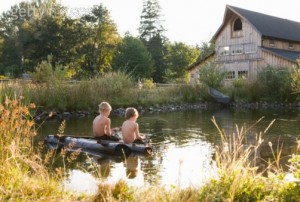
Are you kidding me? I was actually thinking, “I’m building a giant raft that’s gonna float on the pond!” And stuff like that. Which worked out pretty well for me, in the end. Because I now build the ships that the world depends on for efficient bulk product transportation.

(I couldn’t find a picture with a girl in it. source)

OK, no. Building a raft didn’t inform my eventual career. But because I had a lot of fun as a kid. And a lot of time to keep having fun. And no one to tell me I was weird and funny-looking and bossy (all of which was true). And without all that, I don’t know where I’d be. But I’m pretty sure I like it better here.

So I don’t really mind that my life has been a massive experiment. Any experiment that involves that many fantasy novels and late mornings in bed seems like an amazing idea. Even now.
You have read this article alternative education / DIY Learning / going to Harvard / homeschooling / kate fridkis / the colfaxes / TIE / un-schooled.net / unschooling with the title TIE. You can bookmark this page URL https://benncam.blogspot.com/2011/02/i-was-experiment.html. Thanks!