Showing posts with label assessment. Show all posts

Don't judge a fish by its ability to climb a tree - The problem with assessment

Editor's note: This is one of my favorite stories highlighting some of what is wrong with assessment, but first a great comic that captures the fables sentiment and a quote.

‎"Everyone is a genius. But, if you judge a fish by its ability to climb a tree, it will live its whole life believing that it is stupid." -Albert Einstein

The Animal School: A Fable

by George Reavis

Animal SchoolOnce upon a time the animals decided they must do something heroic to meet the problems of a “new world” so they organized a school. They had adopted an activity curriculum consisting of running, climbing, swimming and flying. To make it easier to administer the curriculum, all the animals took all the subjects.

The duck was excellent in swimming. In fact, better than his instructor. But he made only passing grades in flying and was very poor in running. Since he was slow in running, he had to stay after school and also drop swimming in order to practice running. This was kept up until his webbed feet were badly worn and he was only average in swimming. But average was acceptable in school so nobody worried about that, except the duck.

The rabbit started at the top of the class in running but had a nervous breakdown because of so much makeup work in swimming.

The squirrel was excellent in climbing until he developed frustration in the flying class where his teacher made him start from the ground up instead of the treetop down. He also developed a “charlie horse” from overexertion and then got a C in climbing and D in running.

The eagle was a problem child and was disciplined severely. In the climbing class, he beat all the others to the top of the tree but insisted on using his own way to get there.

At the end of the year, an abnormal eel that could swim exceeding well and also run, climb and fly a little had the highest average and was valedictorian.

The prairie dogs stayed out of school and fought the tax levy because the administration would not add digging and burrowing to the curriculum. They apprenticed their children to a badger and later joined the groundhogs and gophers to start a successful private school.

Does this fable have a moral?

Note: This story was written when George Reavis was the Assistant Superintendent of the Cincinnati Public Schools back in the 1940s! This content is in the public domain and free to copy, duplicate, and distribute. If you would prefer a full-color, illustrated book, one is currently available from Crystal Springs Books at1-800-321-0401 or 603-924-9621 (fax 603-924-6688)
You have read this article assessment / differentiated instruction / differentiated learning with the title assessment. You can bookmark this page URL https://benncam.blogspot.com/2012/02/don-judge-fish-by-its-ability-to-climb.html. Thanks!
Could The Key to Teacher Effectiveness Mean Dropping Certification Requirements?


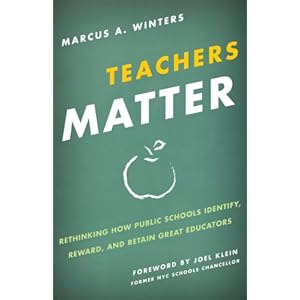
Teachers Matter: Rethinking How Public Schools Identify, Reward, and Retain Great EducatorsMarcus A. Winters explained that there is no correlation between certification and teacher effectiveness at a recent Manhattan Institute for Policy Research event held to announce the publication of his new book, “Teachers Matter.” Winters went on to propose the idea of  removing the barriers to becoming a teacher, suggesting that since there is no correlation between certification and teacher effectiveness, anyone with a college degree should be given the opportunity to teach if they are able to find someone to hire them. The fact is that many of us who went through teacher preparation and certification programs know they were not very helpful when it comes to the realities of the classroom. It is no surprise then that such certification has little impact on student success.

I think Winter’s idea deserves some attention, particularly in the case of secondary studies, but I wonder why he believes that a college degree should be required. If you are an expert in your field, chances are you may have reached this success without such a degree. Especially, if we consider experts who may be interested in taking up teaching upon retirement from their career. Academic inflation is only a recent phenomenon. Historically the majority of careers i.e. business, programming, entertainment casting or directing, writing, advertising, photography, art, etc. did not require such certification for success.


When it comes to college, the jig is up. As the college grads who are occupying Wall Street and other places are happy to tell you, their degree often does little to prepare them with the skills they’ll need for success in a number of careers today. So, let’s take the college degree out of the equation too.

What if instead of requiring individuals to jump through certification hoops, we filled our secondary schools with real-world photographers, journalists, scientists, businesswomen, and others. These people also might not necessarily be employed full-time at the school. Instead, they may perhaps teach a class or two each semester.  They may take on the important charge of connecting students with mentors in their field, helping them grow their personal learning networks, and supporting them in acquiring apprenticeship and/or internship opportunities.  

For this vision to be effective, we’d need to do something that Winters didn’t give much attention.  We’d need to seriously change traditional evaluation of secondary schools, educators, and students and align it to evaluation metrics used in the field the student was interested in studying.  Instead of grades, students could meet challenges aligned to the real-world needs of their potential future careers. Such challenges might be what lands a student an internship or apprenticeship opportunity.  Perhaps to demonstrate mastery students earned badges that could be earned in a number of meaningful ways, chosen by the students.  Students, educators, and schools, could be assessed on how successfully they acquired such badges.  Additionally, depending on student learning goals, assessment could be further tied to schools if they supported students in reaching their personal success plans that honored not only students interested in an academic track, but also those interested in pursuing a vocational track as they do in countries like Finland.  

When it comes to secondary school, as long as teachers aren’t measured the same old way...with outdated, disconnected, bubble tests, I think Winters might be on to something.
You have read this article assessment / college myth / personal success plan / teacher assessment with the title assessment. You can bookmark this page URL https://benncam.blogspot.com/2011/12/could-key-to-teacher-effectiveness-mean.html. Thanks!

Using TPACK as a Framework for Tech PD, Integration and Assessment.

Henrico County Schools System has adopted the TPACK as the Framework for professional development and 21st Century Learning in the Henrico County Schools System.  Henrico County is one of the largest and earliest districts to pioneer and implement a one-to-one initiative.  They have adopted this model as its conceptual framework to guide their progress towards the 21st Century Learning. The following video will set the stage to provide insight into how this school district uses technology for relevant and real-world learning.


See How Henrico County School District Incorporates Technology into Learning.
Henrico 21 Overview from HCPS Instructional Technology on Vimeo.

To see more videos visit this link.


Below are some essential pieces toward meeting their vision.  


The TPACK Model
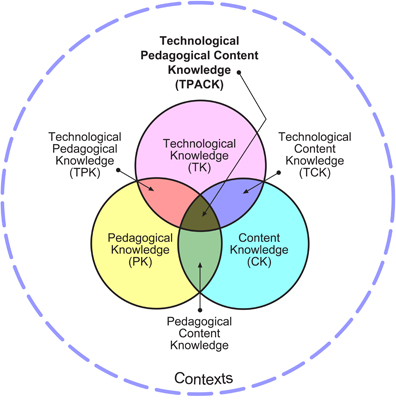
The TPACK Model was created in response to the need to provide a framework around the important pieces of innovating learning with a focus on Technology, Pedagogy, and Content Knowledge.  The overlap of these three components is where the 21st Century classroom is most powerful. Here is general information on TPACK and The general framework of TPACK for Henrico's 21st Century Learning

This is a diagram of the model.


Assessment Tools
  • 21st Century Skills - Student and Teacher Assessment
    This is a fantastic rubric created by the Henrico County School district that students and teachers can use to assess themselves and have a conversation with coaches, advisers, etc on where they are, where they want to be and how to get there. Interestingly findings generally indicate that students and teachers are not at the same level.  
  • Observation Tool for Assessing TPACK evidence
    These instruments have been developed to help researchers and teacher educators to assess evidence of teachers' knowledge for technology integration, or TPACK (technology, pedagogy, and content knowledge). All of the instruments available at the site have been tested for multiple types of reliability and validity, and have proven to be robust tools.
  • TPACK Survey tool for Pre-service Teachers
    Technology assessment tool for pre-service teachers.


Reflective Friends
Henrico County Schools also uses something called The Reflective Friends which is a process designed to provide participating schools with objective data on their efforts to build 21st century learning environments.  Through a series of systematic classroom observations and interviews with teachers and students, a profile of trends in classroom instruction (content, pedagogy, and technology) will emerge.  These data become good information to be used for future development of your school program. Here is a Reflective Friends Sample Report.


Technology Infused Lessons
The teachers write lessons incorporating the elements of the TPACK model. These lessons are vetted and posted on their professional development space.  What is great about these lessons is there is a community that can comment on the lessons and rate them.  They use the Wordpress platform to host the lessons.  What I would add to this, (which may exist or be in the works, but I couldn’t find it) is a way to sort the lessons by topic and technology used as is done with this bank of lesson ideas to innovate learning. There are tags, so I imagine this will become available.  I’d also recommend they add technology used and/or software used.  This way people using the same tech or software can connect.  An obstacle they had in ensuring the lessons were vetted was the amount of manpower and funding it took to do so. If you don’t have funding or manpower where you work, you may decide to let teachers self publish and viewers can take a look at the material and incorporate what they like and leave behind what they don’t like.  


Henrico County is using some valuable tools and provides helpful insights for other schools and districts moving toward providing students with 21st century learning experiences.  

To view the webinar visit this link.  

Thanks to Henrico County School District Tech Director Tom Woodward for sharing the innovative work of his district.  Tom Woodward blogs at http://bionicteaching.com and can be reached via Twitter at @twoodwar

You have read this article assessing innovation / assessment / promising practices / school planning with the title assessment. You can bookmark this page URL https://benncam.blogspot.com/2011/03/using-tpack-as-framework-for-tech-pd.html. Thanks!

Are Report Cards Really the Best Tool for Capturing Student Learning?

I recently become a fan of Joe Bower's blog, "For the Love of Learning" where he spends a lot of time explaining why he despises grades and wants to abolish homework. He shares the reasons for his sentiment as well as many alternatives.  You can read about his dislike of grades here and his dislike of homework here.  He's also a fan of Alfie Kohn who has provided the foundation for many of his beliefs and in his Museum of Education post, he shares a collection of his poignant articles like grades provide little to no information for students to use in order to actually improve. 


As I reflected upon my own experience as a learner I realized that my report card had summed up my whole year or entire college experience with a few computer-generated numbers or letters that made me easy to quantify for school report cards and district report cards and state report cards and maybe federal report cards, but they didn't really say much about who I was as a learner.  


I then took a look at how many unschooling and homeschooling families report on student learning collected at askpauline.com at this link where you'll find samples like K's 3rd grade summary/log, A's 7th grade unschooling summary, and many more.  When you read these ungraded reports of how children spent their year, you get such a deep insight into who these children are, what their passions are, and how they spent their year.

Compare that to typical report cards our students get today and you'll easily be able to tell who's got it right when looking at "The No Child Left Behind" accountability lead system of better ed = more tests and harder tests OR the Joe Bowers and Alfie Kohns of the world. 

You have read this article Alfie Kohn / assessment / grading / Joe Bower / personalized assessments / portfolio assessment with the title assessment. You can bookmark this page URL https://benncam.blogspot.com/2011/02/are-report-cards-really-best-tool-for.html. Thanks!

We would prefer not to take your tests.

This was also published in the Huffington Post.  You can check it out there along with the several dozen readers comments here.

Around the nation more and more school districts like New York City are considering making teacher performance ratings public. One of the many problems with this, simply put, is that the state tests which these tests are based on, well...they suck. Yep. I said it. My background is in K - 8 as a literacy and technology as a former literacy coach, tech coach, library media specialist, and current innovation manager who spent many days grading these subpar assessments. Because of my background and experience, I’m going to focus on the high stakes standard literacy tests K - 8 and explain why they suck.


Background In Reading Assessment
Students read at different levels. Each level has attributes associated with it and there are strategies that learners can take to move to the next level. Teachers assess student reading levels with something called a running record. Today with technology, these readings can even be recorded, so if necessary, the student’s actual running record or reading assessment could be shared. Teachers generally assess student reading at the beginning, middle and end of the year and can easily measure the growth of a student say from a G-Level reader to a J-Level reader. This makes sense as a measurement of student learning. It also allows for students to independently take ownership of their reading level and it is very easy to get families involved in strategies to support students. 


The Problem with State Reading Tests
State reading tests provide all students on a grade level with the same test. While the test is an accurate measure of the students who fit the reading level the state arbitrarily has chosen, most students are left behind either because the reading level is too advanced or too easy. In essence the tests assess how well students are doing on something they can’t read well yet...Answer: Not very well. OR...we assess them on something that is below their reading level...So we don’t know growth, we only know they can read that well. 


In another words, we’re not really assessing student reading level.

What we do know is that developmentally children become ready to read at different ages (click this link to hear John Taylor Gatto's thoughts on this). We also know that forcing reading on children is actually a deterrent for attaining growth. Finally, we know two extremely important factors in the attainment of reading fluency is family involvement and socio economic class. 


None of these factors are in the control of the teacher!

What I propose is that we stop creating a test that makes teachers and students absolutely bonkers, and instead use the running record reading assessments that teachers already use to measure student reading level. Though, while this solves this issue of assessing reading more accurately, it doesn’t take into account that the factors that accelerate reading, really have nothing to do with the teacher. 


On to writing...
As shared in Four Reasons Innovative Educators Should Boycott Standardized Tests, the problem with the way writing is assessed in standardized tests stems from the fact they use an outdated and irrelevant method of assessment. If teachers are doing their jobs effectively, students aren’t just focusing on hand it in teaching. Instead they are focused on “publish it” learning, meaning students are communicating authentically to real audiences using the learning style that best matches their strengths. Student work can ideally be kept in a portfolio that can be assessed for writing achievement.

Wouldn’t you want to measure a teacher by how she helps her students publish for authentic audiences in area of deep personal passion rather than how she helps a student write about a topic the state dictates?

The problem with the current method is this.
  • We are not measuring what is important. The student’s ability to authentically communicate about topics of importance to them.
  • We are valuing writing as the most important method of communication. While this method works well for some, others may excel at communicating through video, cartoon, animation, audio casts etc. etc. We are losing focus of what is important.
  • Studies show that students empowered to use technology for communicating will demonstrate improvement however, their scores on writing the old fashioned way with pen and paper will decrease. Sadly, I’ve seen teachers refuse to let students use their own technology because they didn’t want their test scores to decrease. YIKES!!!
Not only is all of this bad enough, but these are high stakes tests for students too, meaning, if they don’t pass, they don’t move on to the next grade level doomed to sit through the same stuff that didn’t help them learn before and putting them in a category that diminishes their chances of success in the future.

This should give just a little insight into why these “teacher assessment” are really not the right way to go. If you’re convinced, you might be thinking, okay, that sounds nice, but there’s nothing we can do. The state makes us take these tests. 


There is a movement bubbling up called The Bartleby Project started by John Taylor Gatto which you can read about here. It’s a call to action for students to simply write across the top of their test, “I prefer not to take your test.” The premise being that students and parents should be empowered to decided how their child should best be assessed and not forced by the state to be subjected to very questionable assessments. 


The project has a growing following with a Bartleby Project Facebook Page, a number of reprints of John Taylor Gatto’s Bartleby Project proposal from his new book,Weapons of Mass Instruction floating around the web, and a huge round up of videos on You Tube. I’ve included two X-tranormal creations below.

One is a short video from a child’s perspective and the other is taking from John Taylor Gatto’s proposal for those who prefer watching to listening.


You have read this article assessment / DIY Learning / teacher assessment / unschooling with the title assessment. You can bookmark this page URL https://benncam.blogspot.com/2011/01/we-would-prefer-not-to-take-your-tests.html. Thanks!

ISTE Classroom Observation Tool

Editors Note: As you may have noticed, I list blogs I follow on the bottom right side of The Innovative Educator. From time to time I like to feature posts from these bloggers that I encourage my audience to read as well. Here is one such post.

In his blog, the Techominivore recently wrote a post on the new ISTE Classroom Observation Tool. He shares, "ISTE has developed a wonderful tool to help schools assess their technology integration efforts. The Classroom Observation Tool provides a checklist to guide you in observing how education technology is affecting classroom instruction. The tool is built on top of Adobe Air and allows you to work offline and then upload your results so you can access them from anywhere and share them with your instructional teams."
To find out how to download the tool and learn more visit his blog at http://techomnivore.com/2009/06/11/iste-classroom-observation-tool/.
You have read this article assessment / classroom / ISTE / NETS / observation / technology integration with the title assessment. You can bookmark this page URL https://benncam.blogspot.com/2009/07/iste-classroom-observation-tool.html. Thanks!