Showing posts with label education. Show all posts

Why I Hate Glee, and You Should Too

Guest post by Jacob Gutnicki

What’s wrong with Glee you ask? On the surface it seems innocent enough. This show features students singing rock and pop classics with their own music styling’s in which a motley crew of High School students are grappling with being accepted by their peers. To their credit, the actors and actresses playing the kids are a delight.

It’s the adults I take issue with. Something has to be done about the adults. Let’s start with the Principal. Principal Figgins plays an inept out of touch administrator. If that is not enough, every teacher in the building has significant social-emotional issues. The message of the writer is clear. It is no wonder why our students are failing. Look at their teachers. They are a bunch of losers!

To be fair, I understand it’s a television show with elements of humor. I also understand that some teachers do have significant issues. I myself have written about such subject matters. However, I think Glee’s depiction of educators are often irresponsible at best and more likely feeds into a political narrative that is bent on disrespecting all that teachers do. Additionally, the core audience for this show is the youth we teach. One should also keep in mind other current shows such as the Simpsons lampoons teachers and administrators as buffoons. With this in mind, I would suggest that the Glee writers take a cue from “The Wire”. This show presented an honest look at the challenges and opportunities teaching inner city kids presents. At the same time, it did not resort to the disrespecting the work of pedagogues.

Having said that, I do not truly hate Glee. However, I think it is important to raise awareness of these issues as the subtle narrative left unchecked reinforces some of the worst behaviors that certain political operatives enjoy fibbing about. In the end, there are many issues with respect to education that require review. However, addressing such issues must be done with honesty and not foolish rhetoric.

You have read this article education / Glee with the title education. You can bookmark this page URL https://benncam.blogspot.com/2010/09/why-i-hate-glee-and-you-should-too.html. Thanks!

Misunderstood; A Child’s Perspective

By Jacob Gutnicki


They look at my face

And say, is he in outer space

They say, what a waste

He’s playing with toothpaste

I say, look at me

Walking on my knee

Bet you think it’s crummy

I think it’s very funny

I have been call wild

I am the autistic child

Don’t expect me to speak

Just because you say eek

Don’t be in a funk

Because I play with junk

Some think I am a foolish prancer

They don’t know I grow up to cure cancer

You have read this article Autism / education / poem with the title education. You can bookmark this page URL https://benncam.blogspot.com/2010/07/misunderstood-childs-perspective.html. Thanks!

2110; An American Digital Odyssey

By Jacob Gutnicki


Today in class we were told that we were going to research how people lived in the early 21st century. This assignment will include the following components;

On Tuesday we will open a time capsule buried 100 years ago. Our task will be to read the time capsule entry, take notes on what we read, and conduct further research on what we have uncovered. Our research will include making use of the International Digital Library, interviewing at least 2 elders who lived during that time, and locating primary source documents that show differing opinions. After this is done, we are expected to design a 3D recreation of what we learned.

Well… Tuesday could not arrive quickly enough. In my box, there were a few items. One item was a thick paper document labeled PL 107-110, the No Child Left Behind Act of 2001. My box also included a rectangular box labeled iPod and what appeared to be a cowboy doll. Using the ring on my finger, I scanned the artifacts and uplinked it to the International Digital Library. As it turns out, the iPod was some kind of ancient music and video device used during the early 21st century and the cowboy doll was called Woody from a movie that was popular in the late 20th century.

Finally, there was the No Child Left Behind Act of 2001. This yielded a tremendous number of results with differing opinions. I started to ask a number of elders about No Child Left Behind. They too had opinions that were inconsistent. Needless to say this was very confusing. So… I decided to talk to great gramps. Great Gramps was 98 years old, blunt as ever, and sharp as a whistle. He also probably knew more about this subject as he actually lived around those times.

A little later that day, I visited Great Gramps and asked him about the No Child Left Behind Act of 2001. He said, “You mean NCLB. Why on earth would you want to know about that wretched bill?” I told great gramps that it was homework. He said, “Very well. Let me tell you about No Child Left Behind. It was the age of testing. Students were tested in every subject, every year. Many local school systems also ran 3-5 practices tests a year, along with expensive data stratification systems to determine student weaknesses and strengths. This in turn caused schools to spend an inordinate amount on test preparation activities.”

I said, “It seems so strange and archaic. When did the kids have time to write creative stories, run science experiments, and be a kid? ”

Great gramps said, “In many cases it was not easy. Fortunately, many schools found creative ways to do both and eventually the law was changed. About 75 years later, there was a major grassroots movement that advocated for school programs that foster creativity and inventiveness. After all Thomas Edison only had 4 years of schooling and Ben Franklin only had 2 years of schooling and look at what they accomplished. So… on the 300th Anniversary of the Declaration of Independence (July 4, 2076) No Child Left Behind was not renewed and was replaced with the Innovate our Children Act and as they say the rest is history.”

You have read this article education / fiction / NCLB with the title education. You can bookmark this page URL https://benncam.blogspot.com/2010/07/2110-american-digital-odyssey.html. Thanks!

Innovative Educators Don’t Say, “Hand It In.” They say, “Publish It!

During a recent visit to a school I was disappointed because although the school is noted as being a model technology school I was hearing from students, teachers, and leaders that the students had “handed in” a lot of great work, but none of it was being published. Instead their writing, videos, and podcasts lived mainly in obsolescence in a hard to find folder on their various teacher's computers or in obscurity, tattered on a bulletin board sadly with only some educator chicken scratch on it as its insignificant and sole form of comments and ratings.

I see schools like this all too often. Educators, parents, families are dazzled by their flashy assessment and data systems, charts showing kids progress, and fancy, static, one-dimensional bulletin boards. All this is evidence of what their kids are “capable” of achieving. Isn’t it ironic? All this data, assessment, and evidence that lives nowhere that is authentic, relevant, or important to the actual student we are trying to develop. It takes more than collecting data or creating on computers to be a 21st century school. If educators are not having students publish regularly in thoughtful, authentic, and relevant places they are NOT preparing them for today or tomorrow.

If the first decade of the 21st century was about data driven instruction and assessment, can we make the next decade about realizing potential of the student behind the data and publishing to authentic audience as part of student’s school lives?

When I tweeted, “Educators who ask students to, "Hand it in" rather than, "Publish it" are stuck in the past and not preparing 21st century students.” I received a lot of kudos and retweets, but I also received a bit of push back along the lines that it’s not realistic to expect all student work to be published. My response is this. The authentic publication of student work should be a part of EVERY SINGLE UNIT OF STUDY. If an educator can’t figure out a way to help students publish anything in a unit of study they need to either 1) Rethink the unit or 2) Rethink the assessment. While data in an expensive database may be impressive to educators, leaders, and test prep companies, it is not intrinsically meaningful for students or helping them in an authentic way. So how can teachers change practice and move from a “Hand it in” to a “Publish it” culture? Here are some ideas.

6 Ways Innovative Educators Can Move from “Hand It In” to “Publish it” Teaching


WRITING
Hand it in teaching:
Write a report about [place boring topic or classic book title here] and hand it in to the teacher. If you’re lucky, we’ll place one
copy of your final work on the bulletin board or in the class library.
Publish it teaching:
Publish your own book or work in a group to publish a real book for a real audience,
that can be purchased by anyone in the world who is interested in your topic. After you write your book I will help you promote it in appropriate places. In addition to well-known authors, student written books will also be offered for purchase in book fairs and during fund raising efforts.
Technology used:
Lulu or Blurb
READING
Hand it in teaching:
Read the book I tell you and write a book report which I will read and hand back to you with some comments. Some papers will end up in the trash and some our bulletin board.
Publish it teaching:Join our class online learning network where you will join a group based on the book you are reading. You will select a character from the book whose profile you will take on in the learning network. In the network you will create your profile page, engage in discussions and contribute blog posts as if you were the assigned character.
Technology used:
Ning
MATH
Hand it in teaching:
Read the chapter and answer the questions at the end. Or, complete this worksheet.
Publish it teaching:
Students demonstrate their knowledge of mathematical concepts by creating screencast tutorials that other students can view, rate, and comment on and discuss. Here is an example:
Technology used:
Either Jing, Screentoaster, or Screenjelly
ELL/TESOL
Hand it in teaching:
Translate this passage in your workbook.
Publish it teaching:
Have students create a Voki or use Google voice to share an oral presentation that shares something about themselves that they want other people to know in the language being studied. Set up a place where the Vokis or recordings can be published and where students can comment upon one another’s work. This enables to listen to and respond to each other’s work and even respond with another Voki recording.
This is what a Voki from a French class might look like. Don't forget to click on the comment bubble. This could be comments from the teacher or other students.
Here is what a Google Voice assignment might look like:
Hello class 7-403. Please submit your oral French report to me by clicking on the Google Voice icon below and entering your phone number. Remember your report should be 1 - 3 minutes.


Technology Used:
Voki or Google Voice
Technology used:blog, video, photos

Further reading / ideas:
http://gradcooking.blogspot.com, http://blog.studentcooking.tv


COOKING
Hand it in teaching:
Students learn to cook something. Write down the recipe and cook the meal. At the end of the class they have a cook book of meals with their notes. The teacher grades this and gives it back to the student with comments.
Publish it teaching:
Students learn to cook something. They post on a blog the recipe, how to make it, nutritional facts, and for what a teenager might want to make this meal. They embed a cooking show like video of a different “Kid in the Kitchen” with each post as well as a photo of the finished product. Class members comment on the blog entry and rate and comment on the video. The blog is shared with other cooks and students around the world for feedback, rating and comments.
Technology used:
blog, video, photos
HISTORY / SOCIAL STUDIES
Hand it in teaching:
Read the chapter or read the website and complete this worksheet or complete the questions at the end of the chapter.
Publish it teaching:
The Entire Span of Human History Is In Your Hands! Dominate 6,000 years of history from the Ancient Age to the Information Age. Which forces will you deploy to lead your nation to global prominence? Trade, espionage, diplomacy…war? Whichever path you choose, you’ll experience the pulse pounding thrill and speed of real-time gaming combined with the epic scope and depth of turn-based strategy games – brought together for the first time ever in Rise of Nations. Rise of Nations is a historical real time strategy game. In Rise of Nations, you'll create new cities, improve city infrastructures and expand national borders. Conquer foes through military might using everything from sling-shots to cannons to stealth bombers to nuclear weapons; corner the market on key commodities and consolidate power under your rule; wheel and deal across time with history's eminent cultures.
How often do we tell our students, “The Entire Span of Human History Is In Your Hands!” How exciting is that for students to know? For those wondering why I’m considering this “Publish it teaching” it is because this is a real-time online game. Students are playing just with a computer game. The other game characters are other people…perhaps classmates, perhaps not. The students literally becoming a part of an immersive historical environment where in real time they are a part of history…interacting, chatting, strategizing. They must know the historical ages, conduct research, and be familiar with society at the time period they are in to succeed. And…this is available in multiple languages allowing students with a variety of different languages to interact together.

Take a look at the video that explains the game.
Rise of Nations Video from Ted 21C on Vimeo.


You have read this article 21st century educators / education / innovative / publish / teaching with the title education. You can bookmark this page URL https://benncam.blogspot.com/2009/11/innovative-educators-dont-say-hand-it.html. Thanks!

New Web Filtering Policy for NYC DOE Employees

The New York City Department of Education has a new web filtering policy for employees. It will expand the use of its web filtering software, currently covering instructional computers, to cover all DOE computers, including those located in school administrative offices and in all central sites.

This software, called Websense, will transparently monitor all internet traffic and will automatically block content that is inappropriate, such as adult sites and those containing known security risks. Internal Department of Education websites, as well as internet sites that do not fall into the above categories, will not be affected by the filtering process.

If employees feel a particular website has been mis-categorized and/or is needed to perform job-related functions, they may contact the help desk at (718) 935-5100 to request an exception. When attempting to access a page that has been categorized as inappropriate, users will be re-directed to a block page like the one posted here.
You have read this article education / web filtering with the title education. You can bookmark this page URL https://benncam.blogspot.com/2009/06/new-web-filtering-policy-for-nyc-doe.html. Thanks!

Five Innovative Ideas for Celebrating Women’s History

March is a time when many school teachers celebrate women’s history. If you are among those who are taking some time to recognize accomplishments of women, here are some ideas that innovative educators can use to enhance teaching and learning around this topic.

Xtranormal

Have students research and select an historic woman they admire and make their own movies starring this woman in various possible settings such as 1) A meeting with President Obama 2) A discussion with classmates 3) A meeting with your school principal 4) A topic of your choosing.

Xtranormal’s mission is to bring movie-making to the people. Everyone watches movies and they believe everyone can make movies. Their revolutionary approach to movie-making builds on an almost universally held skill—typing. If your students can type something, they can turn it into a movie.


Remix America

Since the Seneca Falls Convention in 1848, women have demanded their voices be heard in the social and political arenas. In celebration of Women’s History Month, Remix America will temporarily suspend the “This Day in History” featured video to highlight seminal moments in Women’s History. How better to celebrate these women than to provide students with original source material to study and discuss? Every day in March, visit the site for a new clip highlighting the speeches and essays of these rebels, these visionaries, these pioneering feminists.

Students can interact with all of these videos by using the online, free video editing tool to cut and remix these clips into Women’s History montages. Innovative educators can also visit the Remix America Blog to find featured content and commentary about why these source materials are important and relevant to today.


SMARTBoards

Interactive whiteboards are powerful tools to engage visual and auditory learners and accomplish the first rule of teaching - "First get their attention and then keep them engaged." To help to help celebrate Women’s History Month Tequiment has put together a collection of lessons, websites and a new question set for a Jeopardy-style Quiz Game. You can view these resources by visiting their blog where you will find the following resources: Women's Rights Quiz Set, Women's History - Colonial Women, Women of the Civil Rights Movements, Women's Suffrage of the 19th and 20th Centuries, Los Animales de la Granja.


Create a Social Network

Capitalize on your student's interest in social networking sites like MySpace and Facebook and Create a Social Network learning environment for your students. Innovative educators are coming up with all sorts of creative ideas to use social networks to engage students. How about creating a network with women historical characters? Students can take on the persona of a historical woman they admire, create their personal page for that character with questions you and your students agree upon, engage in discussions, join groups that character would be involved in engage in chats as the woman they have selected, upload videos (which can be rated and commented on), and publish blog posts. One of the most popular social network creation tools, Ning is allowing educators to create free educational social networks. For more ideas about using social networks in education visit Ning in Education. If you've never participated in a social network I invite you to get the experience of participating by joining The Innovative Educator Social Network. This will enable you to have a better idea of how you can incorporate a social network into your teaching and about the value of Social Networking for Innovative Educators.


Note: In some school districts Ning is blocked. Create your social network remotely and work with your administrator or technology specialist to unblock the site you have created in advance.


Voki
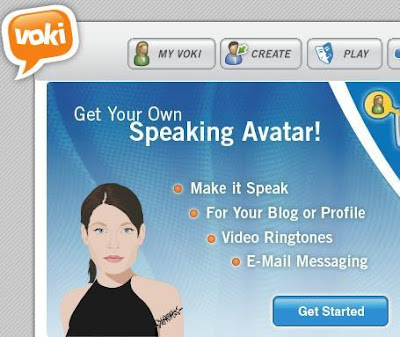
Have students select and research a woman they know that they admire and create a Voki that either shares, 1) how she has contributed positively to women in her life 2) why it is important to recognize women’s accomplishments 3) a topic of your choosing.

Voki enables students to express themselves on the web using a talking character.


Students can customize their Voki to look like and/or take on the identity of lots of other types of human and nonhuman characters. Vokis can speak with the student’s own voice which is added via microphone, upload, or phone. Students can also choose to insert text and have the Voki use a variety of existing voices with more than a dozen different male and female accents to choose from.


Once the student Voki’s are created they can be inserted into a class blog, wiki, website, and more. From there the school community can comment on and discuss one another’s work and keep the conversation going.


These are just some ideas to inspire innovative educators in their upcoming work with students in recognizing women’s contributions. I invite readers to share your thoughts, feedback, or experience implementing one these ideas or one of your own.


You have read this article arts in education / education / Ning / SMARTBoards / social networking / Social Networks / technology / Voki / Women’s History / women's history month / Xtranormal with the title education. You can bookmark this page URL https://benncam.blogspot.com/2009/02/five-innovative-ideas-for-celebrating.html. Thanks!

25 Random Things Innovative Educators Can Do To Enhance Teaching and Learning

While I read Ah, Yes, More About Me? Here Are ‘25 Random Things’ and 25 Things I Didn't Want to Know About You and contemplated the efficacy of actually coming up with these things, I realized I’d like to change the assignment slightly. Instead, I did a sort of year in review to summarize 25 random things innovative educators can do to enhance teaching and learning.

Here they are:

First Thing: Collect and save inspirational quotes.
Read: Ten 21st Century Education Quotes I Carry With Me

Second Thing: Develop your personal learning network
Read: 5 Things You Can Do to Begin Developing Your Personal Learning Network

Third Thing: Go paperless.
Read: How I Lost 20 Pounds in One Month On a Paperless Diet and Do More with Less by Going Paperless

Forth Thing: Take control of your digital footprint
Read: Ideas for Making a Purposeful and Professional Digital Footprint

Fifth Thing: Visit schools known for educating innovatively
Read: Immunization for an Uninteresting Curriculum Found at the iSchool, The Power of 21st Century Teaching and Learning Brought to Life at Bronx Middle School CIS 339’s Open House, You Can Get a Dalton Education at a NYC Public School, Bridging The Digital Divide in NYC, Science Leadership Academy – Lessons Learned, and X's & O's for the OLPC XO - A View from the Classroom.

Sixth Thing: Be aware of ways to keep students safe in the 21st Century.
Read: HOW DO I HELP MY CHILD LEARN TO USE THE INTERNET WISELY? and New Technology Helps Keep Kids Safe on Cell Phones

Seventh Thing: Help your school go 1-to-1
Read: Low Cost Computing Options That Will Enable More Educators to Consider 1-to-1 Environments

Eighth Thing: Tap into your schools best resource – students.
Read: Starting a Student Support Team in Your School, 5 Innovative Ideas for Student Teams that Support 21st Century Teaching & Learning, Partnering with Student Tech Wizards to Provide Professional Development at Schools, and 8th Grader’s Advice for Questions Peers Might Ponder On Their Road to Achieving Success

Ninth Thing: Join A Social Network
Read: Why Every Parent and Teacher Should Learn MySpace and Facebook and A 30-Day Guide To Losing Your Digital as a Second Language (DSL) Accent and YOU'RE NOT TOO OLD FOR FACEBOOK

Tenth Thing: Start your own social network
Read: Social Networking for Innovative Educators and Keep Your Students Connected This Summer with A Social Network

Eleventh Thing: Figure out ways to use technology to connect with English language learners.
Read: 5 Translation Tools That Serve as Fantastic Resources for Students Who Are ELL, Foreign Language, and Struggling Readers

Twelfth Thing: Watch TED Talks for inspiration.
Read: Recommended Viewing for Innovative Educators

Thirteenth Thing: Start a blog.
Read: Why I started a blog and why maybe you should too and Great Way to Find Popular Keywords for Your Blog or Other Published Content

Fourteenth Thing: Lead, don’t follow when it comes to promoting the use of technology to enhance teaching and learning.
Read: Reasons to Promote Engaging Technologies Even Though Schools Filter Them

Fifteenth Thing: Consider the power of using cell phones to enhance education. Start with having students use them outside of school if your school does not allow them.
Read: The Value of Using Cell Phones to Enhance Education and Some Concrete Ways to Do So and Pockets of Potential: Using Mobile Technologies to Promote Children’s Learning.

Sixteenth Thing – Think about your 25 Random Things to enhance Teaching and Learning.
Read: Using 25 Random Things to Enhance Teaching and Learning

Seventeenth Thing: Help your students stay organized.
Read: What’s Up? A Hello Friend Student Planner

Eighteenth Thing: Go to targeted conferences that enable you to achieve your learning goals.
Read: EduCon 2.1 - A Conference Worth Attending and The Confratute Virgin's Guide to Success

Nineteenth Thing: Identify mentors
Read: Developing Mentors from Your Personal Learning Network

Twentieth Thing – Get yourself and students published!
Read: Innovative Educators Can Help Students and Themselves Become Published Authors

Twenty First Thing – Enable students to broadcast themselves with audio and video.
Read: IStream, UStream! We ALLScream for UStream! And Podcast from Your Phone

Twenty Second Thing – Learn how you can begin transforming your school into a 2.0 environment.
Read: School 2.0 Transformation Toolkit - A Recommended Resource for Innovative Educators to "Let the conversation begin!"

Twenty Third Thing – Think about ways you can educate innovatively and determine goals for doing so.
Read: Educating Innovatively

Twenty Fourth Thing – Get to know the technology standards and how they align to various content areas.
Read: An ISTE Crosswalk by Six Major Categories

Twenty Fifth Thing – Join the conversation and begin commenting on blogs.
Read: Comments, Responding, Timeliness via Drape's Takes

These are 25 random things I've recommended this year on The Innovative Educator. I hope I've inspired you to pick a random thing or two to try.
You have read this article 25 Random Things / education / technology quotes with the title education. You can bookmark this page URL https://benncam.blogspot.com/2009/02/25-random-things-innovative-educators.html. Thanks!

23andMe Provides Authentic and Personalized Learning Opportunities in Genetics, DNA, Biology, Health, Geography.

I just responded to the Classroom 2.0 post Teaching DNA from a science teacher who shared, “I'm looking for a website available to students that can answer some of their questions about DNA. That will conceptualize DNA, and allow them to look through the material at their own pace. It can’t be too technical, and I would like it to help spur their interest in the subject.”


As a recent subscriber to 23andMe (whose tagline is, “Genetics Just Got Personal”), I had to chime in. I know that personally, I never retained much of anything I learned in science class because little of it was hands on, and wasn’t taught in a way that allowed me to see how it pertained to my life in a way I needed to care about.


As an adult, when I heard about 23andMe I became extremely excited at the potential to unlock the secrets of my own DNA. As an innovative educator I also reflected on what a powerful learning tool this could be for students interested in this field. Of course there are cost and legal factors that are obvious barriers, but innovative educators don’t let things let things like that stop them.


For those not in the know, 23andMe was selected as Time magazine's "Invention of the Year” and was recently featured on Oprah. It allows you to access and unlock the information contained within your DNA. This means that you will be able to learn about your medical proclivities as well as your true genetic ancestry.


So, how can this be used in the classroom? Even without sending in your DNA for sampling 23andMe puts a lot of the study of genetics and ancestry into context in a way that is more interesting and compelling then what I ever learned in school. The website provides a collection of educational materials to guide educators and learners on a personal journey of genetic discovery. Here are some of the great learning resources 23andMe offers to enable visitors to discover the world of genetics.


A great place to start with students would be with the Variations section which highlights stories of famous people and how their genes affected them. This can be tied to an activity where students reflect on how they think their genes may have shaped who they are or will become. Here is a peak into what that part of the site contains.


Variations

Our genes help shape us from the moment of conception, but they are far from the only determinant of who we are. 23andMe's Variations series explores the human experience through personal stories of the ways genetics touches our lives.

Are Warren and Jimmy Buffett related?

Speed Gene: Fact or fiction?

Drive: The story of Muggsy Bogues, 5'3" NBA star

The Royal Disease


Once you’ve peaked students interest, it’s time to get down to some details about genetics. The site has an area called Genetics 101 which features a variety of easy to understand animated videos. Here is what you will find there.


Genetics 101

Part 1: What Are Genes?

Find out about the basics of cells, chromosomes, and the genes contained in your DNA.

Part 2: What are SNPs?

Learn about the variations in human DNA called SNPs, and how they can be used to understand relationships between people.

Part 3: Where do your genes come from?

Find out how chromosomes and genes are passed down from parent to child.

Part 4: What is phenotype?

Discover how your observable traits, or phenotypes, are the result of interactions between your genes and environment.


The site also has a connection to history and geography. This is a great resource for teachers focusing on history, social studies, ancestry, or geography. Here is what you will find.


Human Prehistory 101

These videos follow the path of our human history from the birth of our species in Africa to the present day.


Human Prehistory: Prologue

Find out how our human story begins, nearly 200,000 years ago in Africa.


Part 1: Out of (eastern) Africa (coming soon)

Learn how humans traveled out of Africa for the first time.

There are also Genetics Guides on the site. These guides are a useful resource about some basic concepts that come up around ancestry and genetics. They serve as a valuable reference for people who are new to the study of genetics and ancestry. The guides include: Key Words About Genetics and Key Words About Ancestry.


I should be getting my 23andMe results soon and I am very excited about what I might learn. I think I’m most interested in the nature vs. nurture personality traits, but also, possible medical issues. I’ll be sure to post on what I find along the way.

You have read this article 23anMe / education / Science / technology with the title education. You can bookmark this page URL https://benncam.blogspot.com/2009/02/23andme-provides-authentic-and.html. Thanks!