Showing posts with label homeschooling and college. Show all posts

How Self-Directed Learners Earn a Living Without a College Degree

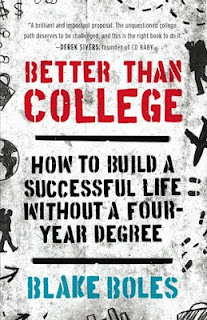
Guest post by Blake Boles, author of Better Than College: How to Build a Successful Life Without a Four-Year Degree. This post is excerpted from the chapter “Financial Security Without College, Part Two”

How do self-directed learners actually make their livings? Can they earn a decent amount of money? Who has taken this path successfully?


There are a number of stories about self-directed learners who skipped or dropped out of college. The following story is one that succinctly illustrates the answers to these questions.Ben Hayes, a lifelong unschooler from New York City, spent much of his youth playing games of all types—video games, computer games, board games, and card games. At age 13, he got an internship at Gamelab, a NYC-based game design company. After Ben spent three years building his skills and demonstrating his value, Gamelab hired the 16-year-old as a full-fledged designer and started paying him a steady income.

At the same time, Ben was intensively playing Magic: The Gathering (a card game), working his way up through the tournament system. He soon became one of the top-ranked Magic players, a position that allowed him to explore the world as he traveled to international competitions.


When he turned 17, it seemed logical to Ben to give college a shot. He applied to Parsons, a design school, and was awarded a merit-based scholarship, but after one semester, the choice seemed wrong. Ben transferred to another NYC-based college for a semester, but his classes continued to leave him unsatisfied. He decided to go back to focusing on what he loved, building and playing games. Ben is now 21 and works as the lead designer for Playmatics, a computer gaming startup.


While self-directed learners must embrace their inner entrepreneurs in order to find financial security, they don’t necessarily have to start businesses to make a living. Many, like Ben, simply take jobs that match their passions. After building a solid track record with one or two companies, self-directed learners possess real work experience—an asset that employers value greatly—and their nontraditional educations become a nonconcern. In fact, their backgrounds often can become a valuable distinguishing factor during the hiring process. Another way that self-directed learners make a living is by focusing on what they love, building mastery, and then producing a respected piece of work. They publish articles, build websites, film short movies, code software, or create art, and, when their work garners the attention of a wider community, they figure out how to use their newfound audience to make a living of some kind. Sometimes they perform or compete in a major venue; sometimes their accomplishments go viral on the Internet.

Many self-directed learners do start their own businesses. Sometimes these businesses are wildly successful (think Mark Zuckerberg and Bill Gates), but more often they’re small and simple yet generate enough money to let a young adult live independently, travel often, and do what they love. By embracing entrepreneurship at an early age, self-directed learners give themselves enough time for trial and error so that they can build a reliably profitable enterprise.Sometimes self-directed learning instead leads you back in the direction of formal education, and you find yourself in a cooking school, long-term apprenticeship, high-level training program, or, yes, even a focused college program that provides a route to profitable employment.Finally, many people who don’t go to college gain competency in a hands-on vocation that’s universally valued and unlikely to ever be offshored or automated, such as health services, construction, electrical work, landscaping, cooking, or small-scale farming. They then use the vocation as a part-time income generator or temporary back-up job.


For example, after I finished my self-directed college program (which handed me a degree but absolutely no job opportunities), I took two short and inexpensive courses that trained me as an Emergency Medical Technician and Wilderness First Responder, positions that I then used to work as a medic for summer camps and outdoor education programs. I also exploited my ability to cook for large groups—a skill I taught myself while in college—to earn money in food service while I was working on my writing.


Most college-skipping self-directed learners pursue many of these paths at once. Just as Ben Hayes focused on paid employment while also competing in Magic tournaments and experimenting with college, you can work toward creating a respected piece of work, build a small business, seek meaningful employment, and develop a vocation all at the same time. By keeping multiple opportunities open, self-directed learners build their financial security without forsaking their interests and values in the process.


What about money? Don’t college graduates make more money than nongraduates? On average, yes, they do. But there are a few important caveats.In a 2007 report, the nonprofit college-preparation organization College Board stated that college graduates make $800,000 more in their lifetimes than their non-college-educated counterparts. However, they retracted the number in 2009; the author of the report said that $450,000 may be a more reasonable estimate.[1] When including the costs of student loan payments, forsaken work opportunities, and ballooning tuition fees, the number may even be as low as $280,000.[2] This is still a significant figure, but it is not nearly as much as we’ve been 
popularly led to believe.


The “average” lifetime earning gap also conceals a huge income variation based on one’s college and field of study. Petroleum engineering majors can easily earn twice the income of child and family studies majors. Princeton and MIT graduates typically earn three times as much as Coker College alumni.[3] Graduates with liberal arts degrees from noncompetitive colleges may well earn less than sales managers, real estate brokers, and other people whose positions don’t require a college degree.[4]
Here are a few more reasons why the lifetime earning gap between graduates and nongraduates shouldn’t scare you:
  • When you don’t include graduates of the Ivy Leagues and other elite colleges, the gap in average lifetime income narrows even more.
  • Income is not the same thing as wealth. Many college graduates (and adults in general) may have high incomes, but they might also be up to their ears in debt.
  • Earning a high income can become a detriment to learning how to live frugally, which is an incredibly valuable life skill in the age of the entrepreneur.
  • Money is just money; time is life’s true commodity. If you’re going to college in pursuit of some mythical six-figure income, that’s a poor gamble to make with four precious years. On the other hand, pursuing an adventurous, self-directed education guarantees you a value-filled experience.
Blake Boles is the author Better Than College: How to Build a Successful Life Without a Four-Year Degree, which launched last week (www.better-than-college.com). If you’re a student or teen, you may download the book for free.  Follow Blake at www.blakeboles.com.

[1] Mary Pilon, “What’s a Degree Really Worth?” Wall Street Journal, February 2, 2010, http://online.wsj.com/article/SB10001424052748703822404575019082819966538.html. [2] Ibid. [3] “Degrees That Pay You Back” and “Salary Potential By School Location,” 20112012 PayScale College Salary Report, PayScale, accessed February 20, 2012, http://www.payscale.com/best-colleges. [4] “20 Great Jobs That Don’t Require a Degree,” CNN (CareerBuilder), posted February 24, 2006, http://www.cnn.com/2006/US/Careers/02/24/cb.no.degree.jobs. Specific income figures from various colleges, majors, and professions change annually, so I’ve tried to make statements that will generally hold constant. Crunch your own numbers by visiting sites like PayScale.com or searching online for average earnings.
You have read this article college myth / homeschooling and career / homeschooling and college with the title homeschooling and college. You can bookmark this page URL https://benncam.blogspot.com/2012/06/how-self-directed-learners-earn-living.html. Thanks!

Concerned about Your Child’s College and Career Success? Leave School.

When parents frustrated with school consider homeschooling, one of their first concerns is often this:

Will homeschooling limit my child’s opportunities when it comes to college, career, and pursuing passions such as music and sports?

The answer in a word is:

No.”

Despite the fact that much of society has been conditioned to believe that learning and success happen as a result of teachers in school buildings, those who are living life without school know the opportunities for those who don’t follow the traditional school path are unlimited.  

First, it is important to understand that you don’t need to go to school to get into a great college should that be of interest. In fact many colleges actively recruit homeschoolers.  For example Harvard specifically mentions that they have never required a high school diploma for admission. Stanford University makes clear to home learning applicants that a high school diploma is not necessary for admission. Furthermore, when it comes to college, homschoolers generally fare better than their schooled peers and many of the top colleges seek out homeschooled students.  

Here are examples.

  • MIT
    MIT has a long history of admitting homeschooled students, and these students are successful and vibrant members of our community. Please note that we do not require a high school diploma or GED from our applicants.
  • Princeton
    Princeton welcomes applications from home schooled students. Among the home schooled students admitted in recent years was a student who graduated as valedictorian of the Class of 2002.
  • Harvard
    Homeschooling is an educational asset that Harvard considers favorably when making its admissions decisions. One often sees a self-reliance and independence, as well as intellectual curiosity in people with unusual educational experiences. Homeschooled students do just as well as most all students who come here do. -Dean of Admissions William J. Fitzsimmons
When it comes to career, we all know folks like Michael Dell, Bill Gates (who has done homeschooling with his own kids), Steve Jobs, Marc Zuckerberg, and Richard Branson achieved great financial success without the benefit of a college degree.  However, there are many people who achieved this success without pursuing the traditional school path in K - 12 as well.

Below is a sampling of the types of careers non-traditionally educated individuals (i.e. they have homeschooled, unschooled, opted out, etc.) have held. Following this sampling are resources where you’ll find thousands more.  

Careers of Successful Individuals Who Did Not Follow a Traditional School Path

Presidents

  1. George Washington
  2. Theodore Roosevelt
  3. Franklin Delano Roosevelt
  4. Thomas Jefferson
  5. Abraham Lincoln There are many others!
Scientists
  1. Erik Demaine - Born 1981. Popular Science Mag: One of the Most Brilliant Scientists in America
  2. Dr. Williard S. Boyle - Physicist who won the Nobel prize in 2009
  3. Benjamin Franklin
  4. George Washington Carver
  5. Albert Einstein
Medical practitioners
  1. Clara Barton - started the Red Cross
  2. John Locke - Medical researcher and physician
  3. Florence Nightingale - Nurse
  4. Susan La Flesche Picotte - first American Indian woman physician
  5. Francis Collins - American physician-geneticist, noted for his discoveries of disease genes and his leadership of the Human Genome Project (HGP)
Business Leaders / CEOs / Entrepreneurs
  1. Andrew Carnegie, industrialist and philanthropist, and one of the first mega-billionaires in the US.
  2. Amadeo Peter Giannini, multimillionaire founder of Bank of America.
  3. Joseph Pulitzer - newspaper publisher; established Pulitzer Prize
  4. Anne Beiler, multimillionaire co-founder of Auntie Anne’s Pretzels
  5. Barbara Lynch, chef, owner of a group of restaurants, worth over $10 million.
Athletes
  1. Michelle Kwan - Olympic medalist figureskater
  2. Bode Miller - American alpine skier
  3. Timothy "Tim" Tebow - football player, Heisman Trophy winner
  4. Venus and Serena Williams - tennis star sisters
  5. Jason Taylor - Miami Dolphin football star
Musicians
  1. Louis Armstrong - king of jazz
  2. Michael Bolton - singer, french horn
  3. Lennon Aldort - pianist
  4. Hilary Hahn - classical violin virtuoso
  5. Oliver Aldort - cellist, pianist
Resources used to compile this list
Interesting stories of homeschooler success
  • Winner of 2009 Nobel Prize Dr. Willard S. Boyle homeschooled by mother
  • 15-Year Old Homeschooler is a Hedge Fund CEO in His Spare Time
  • Learn how James Marcus Bach found success in a highly technical field without the benefit or burden of a conventional education.
  • Wondering what life of those who homeschool / unschool is like? Eli Gerson has compiled this collection and I have compiled this one.  
    • Note: You’ll find a lot of these unschoolers pursue fields like writing, travel tours, photography, film making, as well work that deeply considers the environment like Sean Ritchey who designs and builds energy efficient and environmentally friend buildings and homes.  
  • Read about The 
    Unschooled Colfaxes (summary from Rebecca Smith taken from this site) - 
    Grant the oldest, and the original news-making graduate of Harvard, is an M.D. working as the Director of AIDS Research for the city of San Francisco with an Adjunct Professorship at the University of California at San Francisco. He is currently testing vaccines for AIDS.Drew, the second oldest Colfax son, is a death-row appeals attorney in Montgomery, AL. As part of his work, he reviewcols cases of “railroaded” convictions. These are inmates on death row who have been unjustly convicted – and often proven innocent! If this weren’t enough to keep him busy, Drew is also a full-time student at Harvard Medical School!The third-oldest Colfax son, Reed, is a housing-discrimination attorney in Washington, D.C. He is the lead attorney for the Lawyers Committee for Civil Rights. His wife is an environmental attorney in D.C. They have 2 children, a daughter, Bailey, 4 and a boy Justice, 1-1/2.Garth Colfax, the youngest, is working with the developmentally-disabled in Sacramento. He is also an all-around computer expert, being able to repair the computers themselves and also design websites. Garth has been married 7 years and has a little boy, Jared, who is 7 months old."
    Read more about the Colfaxes in this article: Homeschoolers are Home at Harvard

Insights from homeschooling parents in response to alleviating parents concerns about homeschooling and children’s opportunities for success.

  • Melody Templeton - A lot of us would like to know that we are not ELIMINATING options by homeschooling. I think it is a legitimate concern.
  • Sandra Dodd - Ask how many people in prison went to school, or how many impoverished failures went to school. School creates certified failures. Without some people failing, the "successes" won't seem so glorious. It's not a design flaw of school, that a consistent percentage of people fail; it's a design feature. It is planned and maintained.
  • Teri Reed Davis  - It's important to remember that there is going to be a gap of homeschoolers. During MY childhood, it was a fringe thing and was illegal if not just unaddressed by the law. It's a lot more common now and colleges are very open to homeschoolers. Also, many athletes and performers are home educated because schools will not work with them.
  • Cathy Earle - In my little homeschool group of maybe 20-25 kids who have already grown up enough to have graduated from college, there is one lawyer, one student who is med-school bound this fall (passed MCATs and has been admitted to several med schools), one physical therapist with her doctorate, one college professor, one graduate of Princeton (BA) and Cambridge (MA) who is successfully living and working in England in something like computer programming, one scientist who works at the Jet Propulsion Laboratory, one CEO of his own (small) company of video or computer games, one guy who works for Lego and has appeared on Mythbusters and attended Obama's inauguration as Lego's rep.
  • Linda Dobson - Your query inspired this Parent at the Helm post. (Wrote this book because what really matters is how life turns out for the grown child.) 


Want to keep the conversation going? 
Join my group where we discuss non traditional learning options at https://www.facebook.com/groups/homeschoolingunschooling.

You have read this article college / DIY Learning / homeschooling / homeschooling and career / homeschooling and college / unschooling with the title homeschooling and college. You can bookmark this page URL https://benncam.blogspot.com/2012/01/concerned-about-your-childs-college-and.html. Thanks!

15 Key Facts about Homeschool Kids in College

In recent years, homeschooling has seen a rise in popularity, with more and more parents deciding to educate their children outside of school. Some parents (and their friends/family) who choose this path are concerned about their child's ability to move on to college should they choose that path. Things are easier for homeschooled college students today than they were in the past as more and more colleges have seen great success with students from non-traditional education backgrounds.  Today, homeschool students often enjoy easier admission, better college performance, and even the opportunity to enter college with several credits already earned. Read on, and you'll find out more about what the homeschool college student experience is like today.
  1. Homeschoolers often enter college with more credit
    Homeschooled students are able to work at their own pace, and as a result, students have the freedom to move significantly faster than those in a traditional classroom. Michael Cogan, a researcher at the University of St. Thomas, discovered that homeschool students typically earn more college credits before their freshman year than traditional students, with 14.7 credits for homeschoolers, and 6.0 for traditional students. Earning college credit before freshman year can save thousands of dollars and shave time off of a degree. The 14.7 average credits for homeschoolers represent a full semester of freshman year, which is typically 12-15 credit hours.

  2. Homeschool students do better on the SAT and ACT
    Perhaps benefiting from personalized test prep, homeschool students typically score higher on standardized college admissions tests. The homeschool average for the ACT was 22.5 in 2003, compared with the national average of 20.8. The SAT was no different, with a homeschool average of 1092 in 2002, and a national average of 1020. ACT and SAT scores are very important for college admissions and even financial aid, so doing well on these tests is vital to a great college experience.

  3. Homeschool GPAs are consistently higher
    As a homeschooled student, you work on a flexible schedule. Young children may rely greatly on their parents for scheduling and instruction, but high schoolers typically become more autonomous in their studies, learning key skills for success as independent students in college. Research indicates that this time spent learning how to study independently pays off, as homeschoolers typically have higher GPAs than the rest of their class. Homeschool freshmen have higher GPAs in their first semester at college, with 3.37 GPAs for homeschoolers, and 3.08 for the rest. This trend continues with an overall freshman GPA of 3.41 vs. 3.12, and senior GPAs of 3.46 vs. 3.16, indicating that homeschoolers are better prepared for college.

  4. Homeschooled students are more likely to attend college
    Homeschooled students seem to be more likely to participate in college-level education. As reported by the Homeschool Legal Defense Association, more than 74% of home educated adults between 18-24 have taken college level courses. This rate is much higher than the general US population, which comes in at 46% for the same age range.

  5. Homeschoolers are everywhere
    Patrick Henry College is one college that specifically caters to the homeschool population, but homeschoolers are increasingly accepted in a wide variety of colleges and universities. In fact, homeschoolers are now in over 900 different colleges and universities, many of them with rigorous admissions. Some of these colleges include Harvard, Cornell, Princeton, Dartmouth, Brown, and Rice University.

  6. Homeschooled students are more likely to graduate
    Making it to college is one thing, but actually sticking around and graduating is another. Students who have homeschooled will typically do better than other students, with a slightly higher retention rate, at 88.6% vs 87.6% for traditional students. Graduation rates show a higher disparity between homeschoolers and the national average, with 66.7% of homeschooled students graduating, compared to 57.5%.

  7. Some colleges actively recruit homeschool students
    Homeschool students have proven themselves to be so outstanding that several colleges have begun to actively recruit them. Boston University, Nyack College, and Dartmouth are among them, with a Dartmouth College admissions officer recognizing, "The applications [from homeschoolers] I've come across are outstanding. Homeschoolers have a distinct advantage because of the individualized instruction they have received."

  8. Homeschooled students are very likely to succeed in college
    Research and probability indicates that homeschooled students typically do very well in college, not just academically, but socially as well. Skills learned in homeschooling translate very well to the college campus, with strong self-discipline and motivation. Colleges recognize this advantage, including Brown University representative Joyce Reed, who shares, "These kids are the epitome of Brown students." She believes they make a good fit with the university because "they've learned to be self-directed, they take risks, they face challenges with total fervor, and they don't back off."

  9. High school transcripts are often not required for college admissions
    Although traditional students will typically be expected to submit their high school transcript, homeschooled students usually do not need one, submitting other information instead. Sixty-eight percent of US universities will accept parent-prepared transcripts. Others will take portfolios, with letters of recommendation, ACT or SAT test scores, essays, and more, allowing homeschooled applicants flexibility in admissions.

  10. Homeschoolers can play college sports
    As long as they meet standardized guidelines, homeschooled athletes can be awarded freshman eligibility to participate in college level sports. The number of homeschooled students participating in sports is growing as well, with up to 10 each year in 1988-1993, and as many as 75 students in the late 90s. Homeschool waiver applicants are typically approved, and in the 1998-1999 school year all applicants in Divisions I and II were approved, indicating not only an increased interest in college sports from homeschoolers, but an excellent openness in participation.

  11. Many homeschoolers are National Merit Scholars
    The National Merit Scholar program is an academic competition offering prestige and cold hard scholarship cash for high achieving students. The number of homeschool National Merit Scholars is increasing at a high rate: in 1995, there were 21 homeschool finalists, compared with 129 in 2003, a 500% increase. Homeschoolers are clearly doing well in their studies, and as a result, are reaping the rewards in scholarship money to use in school.

  12. Homeschooled students may have higher college acceptance rates
    Colleges and universities often recognize that homeschooled students tend to be exceptional in their academic performance, and combined with advanced studies and extracurricular activities, make great candidates for admission. In addition to actively seeking out homeschooled applicants, colleges may also be accepting more of them. In the fall of 1999, Stanford University accepted 27% of homeschooled applicants. This doesn't sound like a lot, but it's an incredible number when you consider that this rate is twice the acceptance rate experienced by public and private school students admitted in the same semester.

  13. Homeschool students are often in honors programs
    High achieving homeschool students can benefit from advanced curriculum in college, which is why so many of them end up in honors programs once they go on to study at universities. At Ball State University, most homeschooled freshmen were admitted at a higher level than regular students. Eighty percent of homeschool students were admitted to "upper levels of admission," and 67% were in the Honors College.

  14. Homeschooled students may receive federal financial aid
    Due to some confusion in the past, homeschooled students may have had to obtain a GED in order to qualify for financial aid. But the Homeschool Legal Defense Association indicates that laws have changed, and as long as students have completed their education "in a homeschool setting that is treated as a homeschool or a private school under state law," they are eligible for federal financial aid without a GED.

  15. Many scholarships are available to homeschooled students
    Traditional scholarships are often open to homeschooled students, but there are also some created specifically for the homeschool crowd. In an effort to attract stellar homeschooled students for admission, colleges are developing homeschool scholarships. Belhaven offers $1,000 per year, College of the Southwest awards up to $3,150 each year, and Nyack College will give up to $12,000. With the high cost of a college education, these scholarships can really pay off for homeschoolers.

This is a guest post brought to you via Online College
You have read this article college myth / DIY Learning / education reform / homeschool / homeschooling / homeschooling and college / problems with college / unschooled / unschooling with the title homeschooling and college. You can bookmark this page URL https://benncam.blogspot.com/2011/12/15-key-facts-about-homeschool-kids-in.html. Thanks!

You Don’t Have to Go to School or Take the SAT/ACT to Get Into A Good College

As children of many parents continue on their RACE TO NOWHERE treadmills in high school, a secret many are unaware of is that you don’t have to go to school to get into college. I don’t just mean community college.  I mean a very good college. In fact, I don’t just mean a very good college, I mean the best colleges.  In fact as the Learn in Freedom website explains, “Harvard College specifically mentions that they have never required a high school diploma for admission. Stanford University makes clear in a form letter to home learning applicants that a high school diploma is not necessary for admission. 


More and more colleges are following their lead and mentioning admission policies for home learners in their on-line or in printed materials.” Wikipedia reveals that homeschoolers have now matriculated at over 900 different colleges and universities, including institutions with highly selective standards of admission such as the US military academies, Rice University, Harvard University, Stanford University, Cornell University, Brown University, Dartmouth College, and Princeton University.[19]. The Learning in Freedom site provides a list of colleges that will admit students who haven’t attended school here.


Another option home learning students are pursuing is earning college credit at community colleges or online before attending a traditional college. From a financial perspective it might make good sense to earn credits from a more affordable institution in advance of attending a traditional four-year institution.  Another option is to earn college credits through standardized tests such as the College Level Examination Program (CLEP). CLEP is a group of standardized tests that assess college-level knowledge in several subject areas. Students who earn credit by passing the tests.  Over at the College for Homeschoolers site Calfi Cohen shares additional great tips such as colleges that provide a free education for those who meet their requirements, colleges whose programs have students engaging in real world work and experiences, colleges without exams or grades, a college geared toward students with ADHD, as well as advice for those who want to homeschool for college and attend a "virtual" university.


If you’re thinking, “This sounds great, but a student who has not attended school surely must meet some admission requirements.” You are right.  You can see how unschooler, Kate Frikis got into college without school here. Here are things you can do to ensure your home child who learns at home gets into the school of their choice.


How to Prepare for College Admission

Not only can children who don’t attend school get into a good college, as the Learn in Freedom website explains, those who prepare thoroughly can even be admitted with scholarships. The site goes on to explain that colleges that accept home learners rely on various materials in place of high school grades. While criteria will vary widely, here are some of requirements schools may request.

  • GED
  • Grades from open admission community colleges
  • SAT or ACT scores
    • Some selective colleges will admit anyone with a score above a certain level.
    • This is not a requirement for all colleges.  According to FairTest, the Center for Fair and Open Testing, there are more than 800 colleges and universities that no longer require the SAT for some or all applicants. Here is a list of those schools.
  • Extracurricular activities could be a key to getting a scholarship
  • Personal recommendations
  • Portfolios of student work
  • Applicant's personal essay

The College Board, who sponsors the SAT college-entrance exams has created a page devoted to the application process for those who have not attended school that outlines the approach such students must take to be accepted into college.  


Sandra Dodd has compiled some terrific resources sharing how student work can be documented for a portfolio in this blog post and on this page from her site as well as how you can turn the “curriculum” of a home learner into educationese which you can find here and here and here.  Helen Barrett also has terrific information on how to create electronic/digital portfolios using free tools on her site

------------------------
Further reading
College without High School - The Book
The Teenagers Guide to Opting Out of High School
You have read this article college myth / DIY Learning / home education / home learning / homeschooled / homeschooling / homeschooling and college / unschooled / unschooling with the title homeschooling and college. You can bookmark this page URL https://benncam.blogspot.com/2011/03/you-dont-have-to-go-to-school-or-take.html. Thanks!